Meta Andromeda, GEM and GenRecs are Meta's AI systems that decide which ad to show to whom on Facebook and Instagram. On October 28, 2026, Meta announced that all three had been upgraded, and that the performance gains apply automatically without advertisers changing their campaigns. In the same announcement, though, Meta added that results still depend on the goals advertisers choose, the quality of the data they share, and how much they hand over to the AI, so there is still work left on the advertiser's side.
"I hear narrowing your targeting doesn't make much difference on Meta anymore, so what are we supposed to do?" If you run Meta ads, you've probably heard something like this. As more of the ad system fills up with AI, does the advertiser's job really shrink? In this post, I'll walk through what each of Meta's three AI systems does, which stages an ad goes through before it's shown, and what marketers should change in their goals, conversion data and creative.
1. What did Meta announce about Andromeda, GEM and GenRecs?
On October 28, Meta published two posts on its business news site: three new AI innovations in ads ranking and how Meta's ads system matches your ad to the right person. Here's what they say.
- Meta Andromeda: The first stage (retrieval), which picks out candidates worth showing to a person from tens of millions of ads. The new generation routes each ad to specialized "expert" models, so judgment closer to the ranking stage now happens from retrieval onward.
- Meta GEM (Generative Ads Recommendation Model): The foundation model behind ads recommendations across Facebook, Instagram, Reels and off-Meta conversions. It passes what it learns to the smaller models that rank ads in real time. Meta says campaigns with few conversions can also benefit from what GEM learns from other data.
- Meta GenRecs (Generative Recommender): An approach in which an LLM (large language model) reads an ad's text and images and describes it with semantic tokens such as brand, color, fit and style. This lets even a new ad with almost no engagement history build on what was learned from similar ads.
Meta also shared performance figures. It says ad ranking improvements in Q2 2026 increased ad clicks on Facebook by 8.3% and conversions by 15.7%, and that since 2025 GEM has improved conversions by up to 18.9% and ad click-through rate by 12%. This Andromeda upgrade led to 1.37% more conversions on Facebook and 0.24% more on Instagram Reels in Q3. These are all Meta's own figures, so I'll cover how to read them separately in the note further down.
2. Where do the three AI systems work before an ad is shown?
According to Meta's explanation of how ads are matched, a Meta ad goes through three stages before it's shown.
- Retrieval (Andromeda): Narrows tens of millions of ads to the few thousand worth ranking for each person.
- Ranking and prediction (GEM, sequence learning, Lattice): Scores ads based on where the person may be in their shopping journey, how likely they are to convert, the ad's content and the experience of previous buyers. Sequence learning reads the order of what someone does to anticipate what they may need next, and Meta Lattice is a single ranking system that learns across advertiser goals and apps.
- Auction: The remaining ads compete in real time for a single impression.
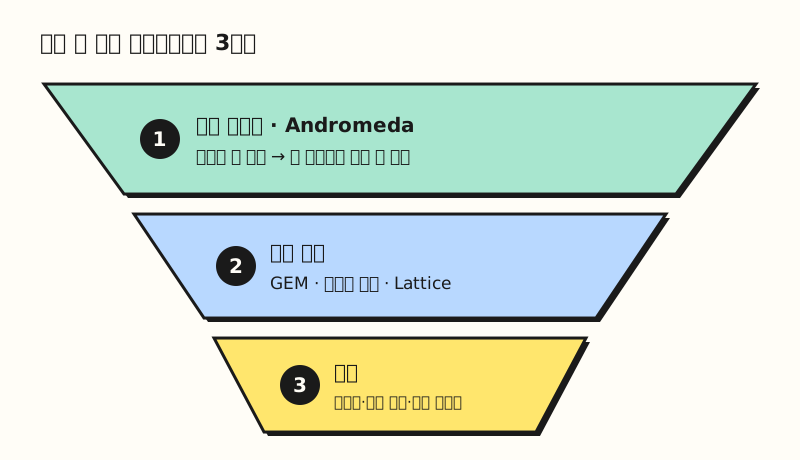 The stages and the systems behind them, laid out in the order Meta describes (figure labels in Korean).
An audition makes this easier to picture. Andromeda is the preliminary round that picks who gets on stage from a pile of applications, GEM and Lattice are the main round judges scoring whom this audience will like, and the auction is the final stage. You can read this upgrade as the preliminary judges becoming far more thorough (Andromeda), the main-round judges gaining more experience (GEM), and first-time performers now being judged with reference to similar performers who came before them (GenRecs).
Here are the three systems side by side on the same criteria.
| Andromeda | GEM | GenRecs | |
|---|---|---|---|
| Stage | Retrieval | Foundation model for ranking and prediction | Describes ad content as tokens, also enriches Andromeda's retrieval |
| What changed | The retrieval model is now split across multiple expert models | Reads 2x longer engagement history with a 2.5x more complex model | An LLM reads text and images and describes them as tokens like brand, color and style |
| What Meta emphasized | Judgment closer to the ranking stage, starting at retrieval | Helps even campaigns with few conversions | New ads and new products with almost no history |
| Where advertisers connect | More varied creative widens the candidate pool | Conversion goals and conversion data | Product information in the creative's text and images |
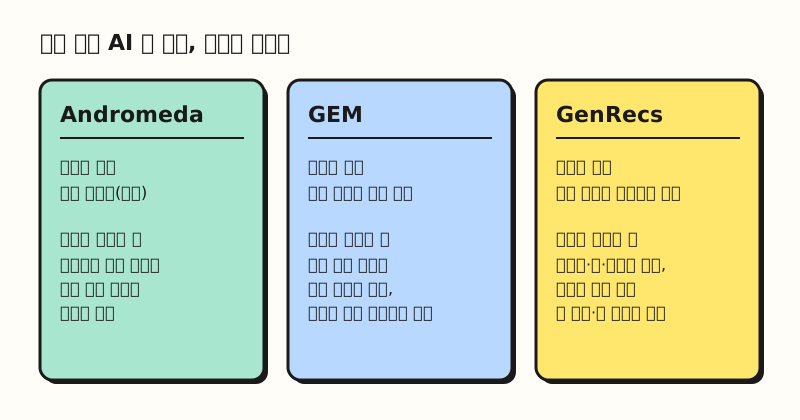 The "Stage" and "What Meta emphasized" rows of the table, turned into cards (figure labels in Korean).
The last row of the table is my own reading of the announcement from the advertiser's side. None of the three systems has its own settings screen, but what they learn from is set by the goals, data and creative advertisers put in. So what decides the winner at the final stage, the auction?
3. So what should marketers change?
Meta describes three inputs to the auction. The bid (your budget and goals turned into a bid per impression), ad quality (the whole customer experience, including what happens after the click) and estimated action rate (the model's prediction that this person will take the action you optimize for). Meta also states plainly that the highest bid or the biggest budget doesn't automatically win, and that a more relevant ad backed by a better customer experience can beat a higher bid.
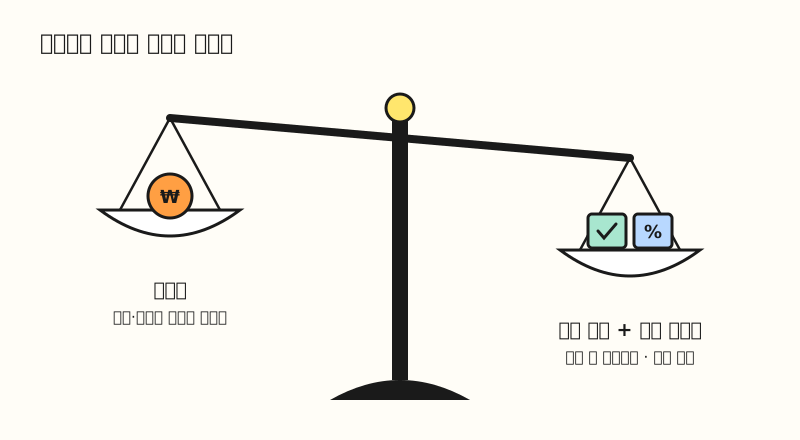 A scale showing that ad quality and estimated action rate add weight together, not the bid alone (figure labels in Korean).
So I think what advertisers should change is closer to the four things below than to slicing targeting ever finer. Here are Meta's recommendations, reordered as a marketer's workflow.
- Make the goal the real outcome: Meta recommends choosing the result you actually want as the optimization goal, not the closest proxy you can measure. If your aim is purchases but you're optimizing for link clicks, that's the first place to look.
- Send conversion values too: Meta says to send the value of each conversion, not just the fact that it happened. It explains that Value Optimization can tilt delivery toward your most valuable conversions.
- Check your measurement data: The Conversions API (a connection that sends conversion events from your server or CRM to Meta) can be added from Events Manager without code if you have a Meta Pixel, and the documentation says to confirm that events are deduplicated against the Pixel events.
- Creative variety and the after-click experience: Meta recommends adopting Advantage+ rather than component by component and supplying more creative variety. It also says shipping, support, product quality and checkout friction affect ad quality, so a landing page review is part of the same job.
I'd suggest deciding how much to hand to the AI based on the state of your account. Here's my rule of thumb.
| Current account state | Do this first | How much to hand to the AI |
|---|---|---|
| Conversion events are inaccurate or duplicated | Start by checking the Pixel and Conversions API | Keep it narrow and fix measurement first |
| Conversions are tracked well but few | Keep the conversion goal, add more creative | Try broadening targeting so GEM can use what it learned from other data |
| You already send conversion values | Consider Value Optimization | Try expanding to Advantage+ budget and placements |
| You have brand constraints on placements | Write the constraints down | Set only that component yourself and hand over the rest |
4. How would you prepare a new product campaign?
Picture the Meta ads manager at an online store launching next season's running shoes. Because it's a new product, the ad has no engagement history yet. Meta's GenRecs tokenization engineering post uses exactly this case as an example: an ad for next season's trail shoe builds on what the model learned from last season's shoe, so it doesn't start from zero even before anyone has seen it. Following this scenario from start to finish, the steps look like this. The order below is an example I put together based on the announcements.
- Set the goal: Set the campaign goal to purchases, and don't optimize for an intermediate metric like add-to-cart.
- Check the data: In Events Manager, if purchase events arrive from both the Pixel and the Conversions API, check that deduplication works and that the purchase amount is passed along.
- Prepare creative: Even for the same shoe, prepare several different images and videos, such as an on-foot shot, a close-up of the sole and cuts for each color, and make product details like the name, use and color clearly visible in the text and images. Since GenRecs reads an ad's text and images to describe it, my interpretation is that the easier it is to tell what the ad is selling, the better it can inherit learning from similar products.
- Hand it over: Leave Advantage+ audience and placements to the system, and if there's something you must restrict for brand reasons, set only that part yourself.
- Judge the results: Look at cost per result or return on ad spend (ROAS) rather than impressions or click-through rate, and check whether the results really came from the ads with a Conversion Lift test, as Meta recommends.
- Check the after-click experience: Fix the places where people drop off, such as shipping information, size details and checkout steps on the product page.
Steps 1, 2 and 5 are the same concerns I covered in conversion modeling and Google Ads data strength. Whatever the ad platform, filling in accurate signals for the AI to learn from is the advertiser's job.
※ Note: How should you read Meta's numbers?
The figures in this announcement come from Meta's internal measurement, and many of them don't come with a baseline or a measurement method. When reading them, keep the following in mind.
- Maximums and scope: GEM's 18.9% is described as "up to" in the October 28 announcement (the October 13 GEM engineering post gives it without "up to," so I followed the more recent announcement), and the nearly 2% gain from generative retrieval was measured in targeted segments on Facebook Feed. Don't read them as how much your own account will improve.
- Differences by platform: The Q3 effect of the Andromeda upgrade differed in size, 1.37% on Facebook and 0.24% on Instagram Reels.
- Regions: The announcements don't mention that the changes apply only in certain countries, but it hasn't been officially confirmed whether Korean accounts see gains of the same size.
- There's no switch: All three systems are improvements running on Meta's side, not menus you turn on or off in Ads Manager. There's no need to look for a feature with a name like "Andromeda optimization setting."
In its March 2025 announcement, Meta introduced four systems, GEM, Lattice, Andromeda and sequence learning, along with improvement figures for each. You can think of this announcement as introducing the new generation of Andromeda and GEM and adding GenRecs, which wasn't in the 2025 post.
Wrapping up
Meta Andromeda, GEM and GenRecs each handle a different stage: narrowing candidates, predicting conversion likelihood and understanding new ads. This upgrade applies without advertisers lifting a finger. That shifts the advertiser's job from picking targeting in fine detail toward choosing the real goal, sending accurate conversion values and measurement data, and preparing varied creative and a good after-click experience. I'll be revisiting the conversion setup in a Meta ads account myself, and I'll share anything that changes. If you're curious about how the auction works, see Meta's explanation of how ads are matched.
FAQ
- What is Meta Andromeda?
- It's the AI that handles retrieval, the first stage of Meta's ad system. It narrows tens of millions of ads to the few thousand worth ranking for each person. The new generation announced on October 28, 2026 routes each ad to specialized expert models, and Meta says it increased conversions by 1.37% on Facebook and 0.24% on Instagram Reels in Q3.
- What's the difference between Meta GEM and Andromeda?
- Andromeda works at the stage that narrows ad candidates, and GEM works at the stage that predicts rankings. GEM is a foundation model for ad recommendations that learns from data across apps and goals and passes what it learns to real-time ranking models. Meta says campaigns with few conversions can also benefit from what GEM learns from other data.
- Do I need to change any settings to get this Meta ads AI upgrade?
- No. Meta says these improvements apply automatically without changing your campaigns. It also says results depend on your optimization goal, the quality of the data you share and how much you hand over to the AI, so it's worth checking your goals, conversion values, Pixel and Conversions API setup, and creative variety.
- Does the highest bid win the Meta ads auction?
- No. Meta explains that the auction looks at the bid, ad quality including the after-click experience, and estimated action rate together, and says the highest bid or biggest budget doesn't automatically win. A more relevant ad with a better customer experience can beat a higher bid.
Related Posts
- Display advertising (DA) basics - A refresher on how banner ad targeting and operations work
- Landing page optimization - Criteria for reviewing the after-click experience
- What is conversion modeling? - How ad platforms estimate the conversions they miss