AI ad labeling rules in Korea aren't a single law but three layers. The AI Basic Act requires businesses that provide AI services to label generated content, and the Korea Fair Trade Commission (FTC) endorsement guidelines require a "virtual person" label on ads where an AI-generated virtual person recommends a product. On top of that, from November 27, 2026, food, cosmetics and pharmaceutical ads that make it look as if an AI-generated virtual doctor or expert is recommending the product are banned outright.
"I used an AI-generated model photo in an ad. Where do I put a label, and what should it say?" As more ad creatives are made with generative AI, I imagine many marketers are getting this question. News articles keep saying "AI labeling is now mandatory," which can make it sound as if every AI-made image needs a label. In this post, let's look at what each of the AI ad labeling rules asks of whom, and in what order to check your ad creatives.
Which rules overlap on AI ad labeling?
Starting with the big picture, four rules of different kinds currently apply to AI ads. Two are laws, one is the FTC's review standard, and one is a draft guideline that was still collecting comments.
| Rule | Applies to | Requires | Timing |
|---|---|---|---|
| AI Basic Act, Article 31 | "AI business operators" that provide AI products or services | Prior notice of AI-based operation, labeling of generated content, clear labeling of deepfakes | In force since January 22, 2026, grace period of at least one year |
| Endorsement review guidelines | Whoever runs the ad, such as advertisers and influencers | A "virtual person" label when an AI virtual person recommends or endorses | In force since June 1, 2026 |
| Amended Food Labeling and Advertising Act, Cosmetics Act and Pharmaceutical Affairs Act | Whoever advertises those products | Ban on ads that may mislead people into thinking an AI virtual doctor or expert recommends the product | In force from November 27, 2026 |
| AI-related labeling and advertising guidelines (draft) | Businesses that promote AI in their ads | Criteria for AI washing and exaggerated performance claims, 8-item self-check | Draft, comments closed November 11 |
To use an analogy, the AI Basic Act is closer to a manufacturing label rule attached to whoever makes the AI tool, while the FTC guidelines and product laws are closer to shelf display rules for whoever puts up the ad made with that tool. Even for the same AI image, the service company that generated it and the company that advertised with it carry different obligations. Once you separate these two, the rest gets much less confusing.
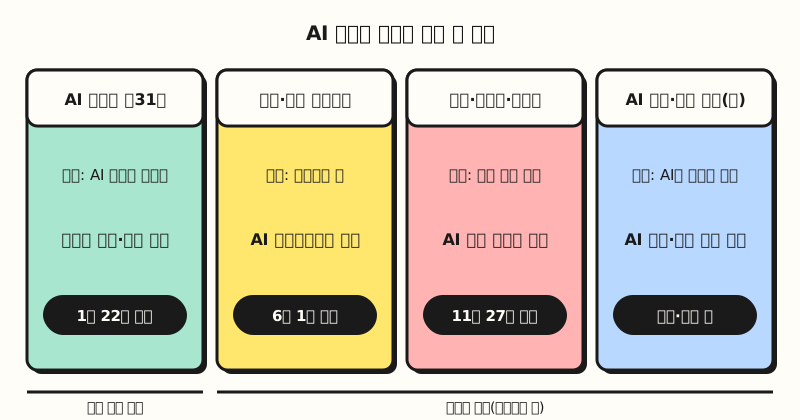 Figure: The AI Basic Act looks at AI service providers, while the FTC guidelines and product laws look at whoever runs the ad. (figure labels in Korean)
Does the AI Basic Act labeling duty apply to marketers?
Article 31 of the AI Basic Act names "AI business operators" as the party with the duty. To provide a product or service that uses generative AI, they must notify users in advance that it is AI-based (paragraph 1), label results as generated by generative AI (paragraph 2), and clearly inform users about virtual sounds, images or videos that are hard to tell apart from reality (paragraph 3).
So does a brand that made ad images with AI fall into this group? The press release the Ministry of Science and ICT (MSIT) issued when it published its transparency guidance in January treats the obligated party as a business that directly provides AI products or services to users, and says users who only use AI as a "tool" for work or creation are not covered. Its example is a studio that makes and distributes a film with a video-generation AI: the studio isn't providing an AI service, it's a user that applied AI to its work, so it isn't covered.
That said, marketers aren't always on the "user" side. Article 2, item 7 of the Act also counts "AI-using business operators," which provide products or services using AI built by another company, as AI business operators. So if you add a generative AI chatbot to your own online store, or open an event page where customers generate AI images themselves and download them, you may become the side that provides an AI service. The methods you can use in that case are set out in Article 23 of the Enforcement Decree.
- Prior notice: State it in terms of use or contracts, show it on the user's screen, or post it in the store if offline
- Labeling generated content: A method people can recognize, or a machine-readable method (metadata, etc.). If you use only a machine-readable method, you must tell users at least once, by notice text or voice, that the content was generated
- Exceptions: When AI use is obvious from the service name or on-screen text, or when used only for the operator's internal work
The MSIT press release explains that content shown only inside the service screen can be labeled flexibly, such as with a logo or on-screen notice, while content that leaves the service through download or sharing needs firmer labeling, such as a watermark, or metadata after a notice. It adds that content hard to tell apart from reality, such as deepfakes, must always be labeled in a way people can clearly recognize. What happens if you break the rules? Article 43 sets a fine of up to 30 million won for failing to give prior notice or failing to follow a correction order, but according to the same press release, fact-finding investigations and fines are suspended during a grace period of at least one year.
How should you label an AI virtual person in an ad?
The rule that reaches marketers more directly is on the FTC side. The FTC revised its Guidelines for Reviewing Labeling and Advertising Involving Endorsements and Testimonials and, from June 1, 2026, added AI-generated virtual persons as a new type of endorser. If you create a virtual person with AI that is hard to tell apart from a real one and have it recommend or endorse a product, you must disclose that the person is virtual in a way consumers can easily recognize.
The labeling methods by medium in the FTC press release are as follows.
| Medium | Where | Example wording |
|---|---|---|
| Text posts such as blogs and online communities | Before the title, or at the very start of the body | "[Includes virtual person]" before the title, "This post includes a virtual person generated with AI." in the body |
| Photos | Near the virtual person, in a color that stands out from the background | "[Virtual person]" |
| Videos | Near the virtual person while they are on screen | "[Virtual person]" |
There's one part that's easy to miss here. Even with the virtual person label, if that person in the ad recommends based on usage experience, like "I've used it for two weeks," and that doesn't match an experience that actually happened, it can be unfair advertising. In other words, the label only tells people the person is virtual. It doesn't turn an experience that never existed into a fact.
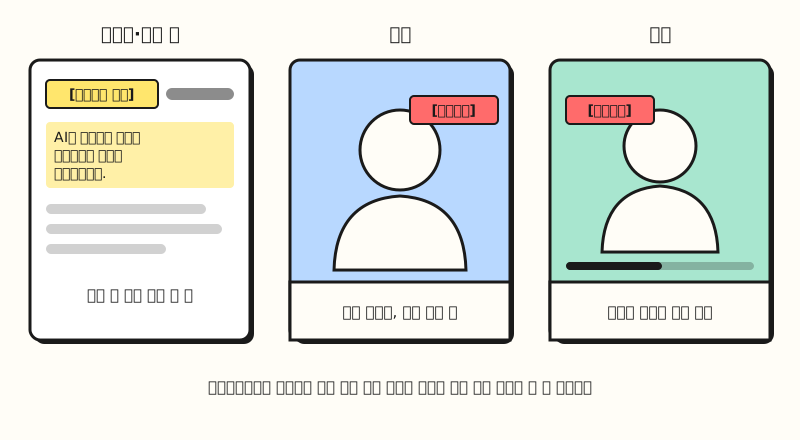 Sample figure: Put it before the title in text posts, and near the virtual person in photos and videos (not an actual ad screen). (figure labels in Korean)
What is banned in food and cosmetics ads from November 27?
Article 8(1)11 of the amended Food Labeling and Advertising Act, promulgated on May 26, 2026, bans ads that may mislead people into thinking an expert such as a doctor, pharmacist, Korean medicine doctor or university professor endorses, recommends, guides or uses a food, by using virtual sounds, images or videos made with an AI system that are hard to tell apart from reality. Article 13(1)4 of the Cosmetics Act and Article 68(7) of the Pharmaceutical Affairs Act, promulgated the same day, add the same rule for cosmetics and pharmaceuticals, and all three provisions take effect on November 27, 2026.
The biggest difference from the virtual person label is that labeling doesn't make it allowed. The FTC guidelines let you use a virtual person "if you disclose it," but for these three product types, ads that make it look as if an AI virtual expert is recommending the product are banned. Under the Food Labeling and Advertising Act, violating this provision can lead to up to five years in prison or a fine of up to 50 million won.
The draft AI-related labeling and advertising guidelines the FTC collected comments on in October also point to this amendment. A case in the draft shows an AI-generated virtual "plastic surgery clinic director" recommending a regular food for reverse-aging effects, and explains that because the Food Labeling and Advertising Act already bans ads where experts recommend food, getting around it with an AI virtual expert is unfair advertising. The same case adds that using testimonials in food ads is itself banned by the Enforcement Decree, so a testimonial format isn't allowed even with a virtual person label.
So what should marketers change?
With several rules in play it looks complicated, but once you split ad creatives by type, what to do becomes fairly clear. Below are judgment criteria I set based on the rules above, and they don't replace legal advice.
| Ad creative | Rule to check first | What to do |
|---|---|---|
| AI-generated staging images such as backgrounds or scenery | AI Basic Act (only if you provide the tool), guidelines (draft) | The FTC draft says staging images unrelated to function or performance are hard to see as subject to labeling under the Labeling and Advertising Act. But label them if they could be mistaken for the actual product or results |
| An AI-generated model holding and recommending a product | Endorsement review guidelines | "[Virtual person]" placed nearby, and remove testimonial-style wording |
| Reviews or recommendation copy written by AI | Labeling and Advertising Act, guidelines (draft) | Don't post them as if they were real customer reviews. The draft explains that polishing a real review with AI doesn't by itself immediately make it an unfair ad |
| AI doctors or experts in food, cosmetics or pharmaceutical ads | Amended product laws (November 27) | Don't use them, with or without a label. Replace creatives already running first |
| Generative AI chatbot or image-generation event on your own store | AI Basic Act, Article 31 | Notice before use, and a generated-content label on downloadable results |
Scenario: November ad check at a health food online store
If you run social ads for a health food online store, you could check things in this order before November 27 (this is a hypothetical example).
- List your creatives: Gather running or scheduled video and image ads, product detail pages and affiliate blog drafts in one sheet.
- Find AI people: Ask your production agency to mark the creatives that feature people made with generative AI.
- Filter out expert staging: Among them, take down creatives with white coats, titles like "director," "pharmacist" or "professor," or a recommending or instructing tone before November 27.
- Fix the remaining virtual person creatives: For virtual persons appearing as ordinary models, put "[Virtual person]" near the person, and replace testimonial wording like "after eating it" with factual information such as ingredients and amounts.
- Reread AI performance copy: If there's copy promoting AI, like "the optimal formula AI found," check whether you can answer the self-check questions in the FTC draft (did you actually use AI, where did you use it, did you describe the effect concretely, and can you prove it objectively).
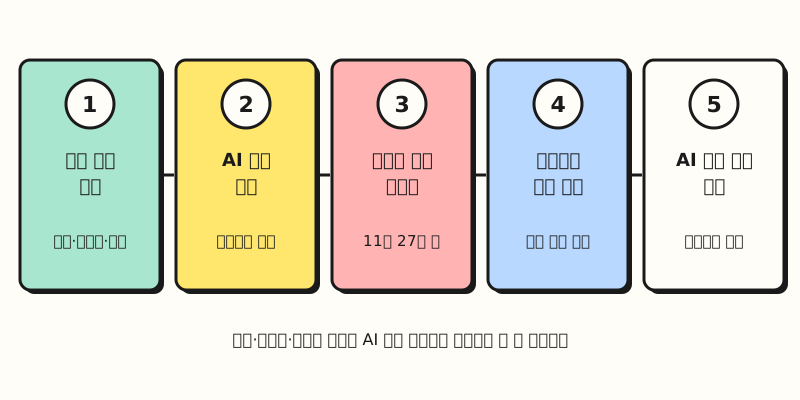 Figure: Before November 27, filter out AI virtual expert creatives first, then add labels to the remaining virtual person creatives. (figure labels in Korean)
When you hand ad production to an agency, adding the lines below to your brief means less to check later (sample wording).
- If a creative includes people or voices made with generative AI, please mark it separately in the creative list.
- Please put a [Virtual person] label near the person while a virtual person is on screen.
- We don't use AI-generated doctors, pharmacists, professors or other experts in food, cosmetics or pharmaceutical creatives.
※ Note: What isn't final yet
- The FTC guidelines are a draft. The FTC said it plans to finalize and distribute them after collecting comments and consulting related ministries, and that they are voluntary compliance material with no legal binding force. The final version may change.
- I couldn't confirm when the AI Basic Act grace period ends. The MSIT press release says "at least one year," and the official materials I found don't state an end date.
- Ad platforms' own policies aren't covered in this post. Each platform has ad policies separate from the law, so please also check the ad policy help pages of the platforms you run ads on.
- This post is a study note based on reading laws and government press releases, so I recommend checking with a legal professional whether a specific creative is in violation.
Wrapping up
AI ad labeling isn't "label everything you made with AI." Which rule applies depends on who made what and what consumers might mistake it for. The things to fix right away are the "[Virtual person]" label for AI virtual persons, and AI experts in food, cosmetics and pharmaceutical ads, which are banned from November 27. I'll share what changed once the FTC guidelines are finalized, and until then, please refer to the check order above.
FAQ
- Do all AI-generated ad images need an AI label?
- The FTC draft guidelines explain that you don't always have to label an ad just because you made it with AI. But if it could be mistaken for a real person, product or result, you must disclose the use of AI, and ads where an AI virtual person recommends or endorses a product need a "virtual person" label under the endorsement review guidelines.
- Does the AI Basic Act labeling duty apply to advertisers?
- MSIT treats the obligated party as AI business operators that directly provide AI products or services to users, and explained that users who only use AI as a tool for work or creation are not covered. However, if you directly provide an AI service, such as adding a generative AI chatbot to your own store, you may count as an operator.
- Can I use an AI doctor in a food ad if I add a virtual person label?
- No. The amended Food Labeling and Advertising Act, Cosmetics Act and Pharmaceutical Affairs Act, in force from November 27, 2026, ban ads that may mislead people into thinking an AI-generated virtual doctor, pharmacist, professor or other expert recommends or endorses the product. They are banned regardless of labeling.
- When do AI Basic Act fines start?
- Article 43 sets a fine of up to 30 million won for failing to give prior notice or failing to follow a correction order. MSIT said it would run a grace period of at least one year and suspend fact-finding investigations and fines during that time, and I couldn't confirm an end date in the official materials I found.
Related posts
- Meta Andromeda and GEM Explained: 3 Stages of Meta's AI Ad Ranking - How AI picks ad creatives and why creative variety matters
- How to Check AI-Generated Images: SynthID Detector and Gemini - How machine-readable AI labels (watermarks) are actually used
- Claude Usage Policy 2026 Update: Fake Reviews, AI Search Rules - Fake reviews and manipulated content blocked on the AI company side