On October 8, 2026, Anthropic published a new version of the Claude Usage Policy (the rules on what AI must not be used for), and it takes effect on November 12. Anthropic says most of the changes simply state existing rules more clearly, but one part directly concerns marketers: the section that gathers fake reviews, sockpuppet accounts, and content that deceives the sources search engines and AI answers rely on into a single clause.
"What if I used AI to write a bunch of reviews and posted them?" When you're chasing a content calendar, that thought has probably crossed your mind at least once, and this update gives a fairly specific answer to it. Working in digital marketing, I'm as curious about "how far I'm allowed to go" with AI tools as I am about their features, so this time I read the policy text myself. In this post, based on Anthropic's announcement and the full text of the new Usage Policy, I'll go over what changed and what marketers should check.
1. What Changed in the 2026 Claude Usage Policy Update?
The Usage Policy applies to individuals using apps like Claude.ai and Claude Code, developers and businesses using the API, customers using Claude through cloud providers or authorized resellers, and even end users of services built with Claude. So if your company uses an external tool with Claude inside, the marketers using that tool are covered too.
The announcement summarizes seven changes.
| Change | Details |
|---|---|
| New deceptive campaigns clause | Rules previously scattered across the election, fraud, privacy, and misinformation clauses are consolidated into one. Applies to all deceptive activity, political or commercial |
| Narrower election clause | Focuses on deceiving voters or disrupting elections. Removes the blanket ban on personalized voting and election targeting |
| More specific weapons ban | Explicitly covers software and components that make weapons work, and arming drones |
| Rewritten surveillance clause | States that the ban on non-consensual tracking covers both real-time tracking and analysis of data already collected |
| Clarified high-risk use case requirements | The requirements themselves are unchanged; which recommendations qualify is now laid out as a list |
| Ban on model abuse | Applies only to extreme cases repeated without purpose |
| Clarified supported regions policy | Prohibits use by people located in unsupported regions, companies incorporated or headquartered there, and companies majority-owned or controlled by people or companies from those regions |
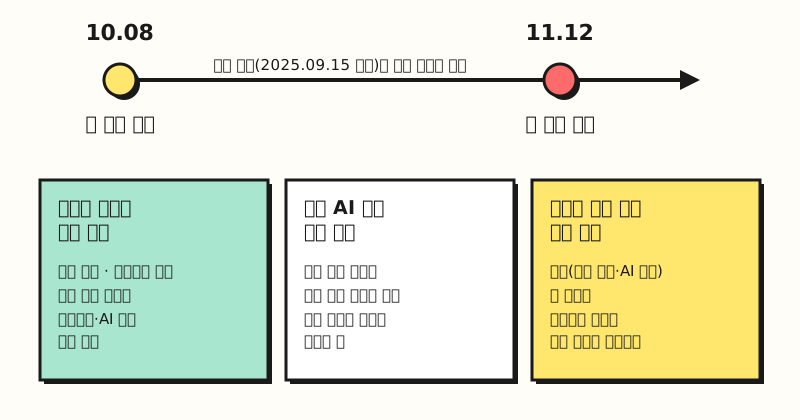 Illustration: a simple summary of the dates and items from the announcement and the policy text. (figure labels in Korean)
So where should marketers look first?
2. Fake Reviews and AI Search Manipulation: What Does the New "Deceptive Campaigns" Clause Prohibit?
The new clause is titled "Do Not Engage in Deceptive Campaigns or Artificial Activity." Translated into marketing terms, the prohibited activities in the policy text look like this.
- Fake accounts and fake reviews: creating fake personas, accounts, or outlets to deceive people about the source, the scale of opinion, or whether they're dealing with a human. The policy's examples include sockpuppets, astroturfing, fake reviews, and bots posing as humans.
- Hiding sponsorship: misrepresenting or deliberately concealing who sponsors content meant to influence public opinion or decision-makers.
- Networks posing as independent outlets: spreading content from the same source across multiple sites or accounts that look unrelated.
- Manipulating search engine and AI answer sources: distributing content that misrepresents its source, authorship, or independence in order to manipulate the sources search engines or AI draw answers from. The policy gives the example of a network of seemingly unrelated sites that corroborate the same claims.
- Building and selling manipulation tools: building tools or infrastructure that support the activities above, or selling them as a service.
The fake review ban isn't a brand-new rule. In the previous version, it sat under the fraud clause as "creating deceptive digital content such as fake reviews, comments, or media," and moving it into the deceptive campaigns clause made the examples more specific. On the other hand, I couldn't find a separate sentence in the previous version about manipulating the sources of search engines and AI answers. If you're a marketer thinking about GEO (generative engine optimization) to get visibility in AI search, this sentence is worth noting.
An easy way to understand this clause is to think of a shill at a market. When the seller pretends to be a customer, stands in line, and shouts "This is really great," people misjudge its popularity without knowing the words came from the seller. AI makes it easy to produce shill copy and accounts like this in bulk, and what the new clause targets is exactly this kind of deception about "who is speaking" and "how many people think so."
In fact, in its September 2026 threat intelligence report, Anthropic disclosed an operation that posted political content on about 70 fake news sites dressed up as independent local media, and says that tracing the operation led to a digital advertising agency. According to the report, the articles carried bylines of reporters who don't exist, and the sites were designed to push up their search engine rankings. The announcement also cites, as background for this clause, cases where commercial companies, alongside state media and government propaganda groups, used Claude to run networks of fake accounts and fake news sites.
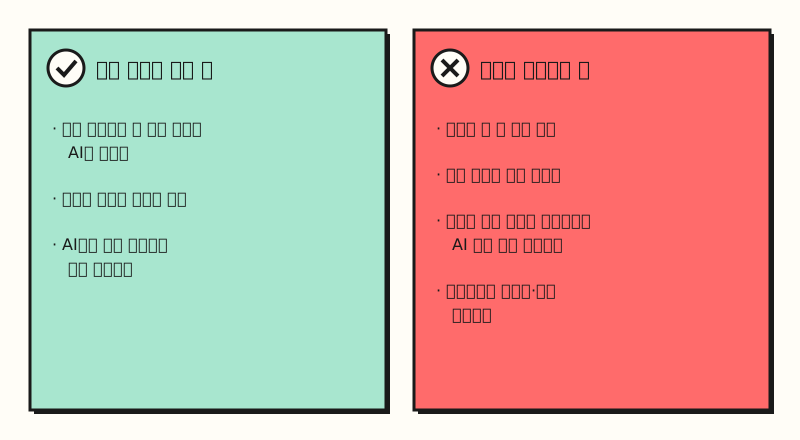 Illustration: marketing examples attached to the prohibited items in the policy text. Whether a specific case violates the policy is up to Anthropic. (figure labels in Korean)
So what rules apply to chatbots that talk directly to customers?
3. What Rules Apply to Customer Service Chatbots and AI Agents?
Consumer-facing chatbots and AI agents that talk directly with external users must disclose that the user is talking to an AI, not a human. The new policy says this disclosure must be made at least at the start of every chat session or placed within the product interface; compared with the previous version, which only said "at the start of each session," showing it in the product interface is newly spelled out. It also says the disclosure doesn't need to name Anthropic, Claude, or the model.
For AI agents, the scope of responsibility is now clearer. The policy states that users are responsible for making sure agents they build or deploy comply with the Usage Policy, including actions taken through tools, browsers, and connected systems. The Claude Help Center's guide to using agents also lists creating artificial engagement through likes or comments on social media and manipulating traffic metrics as prohibited examples. If you're considering automation like handing an agent your social media accounts, this is why you need to check not just the output but whether each action the agent takes stays within the policy.
※ Note: High-Risk Use Cases and Supported Regions
The policy treats uses that may affect health, legal rights, finances, livelihood, or access to housing, education, and essential services as high-risk use cases. In these cases, a qualified person must review the AI's recommendations and have the authority to change them (human-in-the-loop), and the affected people must be told that AI was used. Items close to marketers' work include hiring (screening, ranking, or deciding on applicants) and finance (personalized recommendations to buy or sell specific investment products).
The policy text also lists cases where the requirements don't apply. Work that isn't a final recommendation, such as internal drafting, research, summarization, and analysis, or business operations that don't advise on or decide about a specific individual, are excluded. Based on the policy text, ordinary ad copywriting or campaign data analysis generally appears to be some distance from these requirements. For reference, the previous version included "automatically generating media or professional journalism content for external publication" as a high-risk case, but this item doesn't appear in the new version's list of high-risk areas.
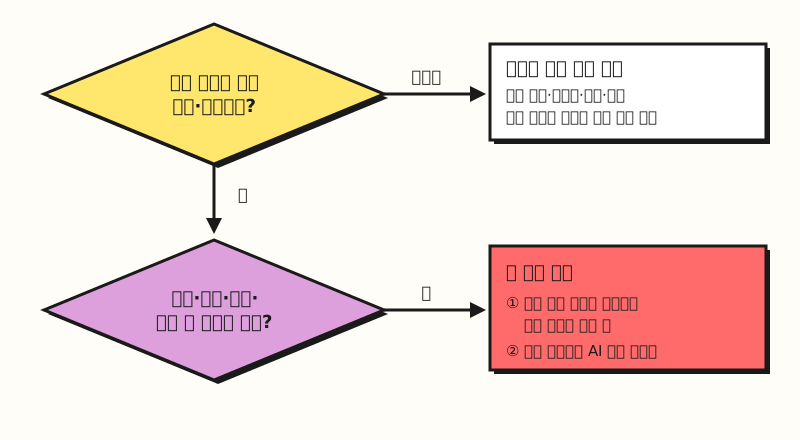 Illustration: a simplified drawing of the high-risk use case requirements and exclusions in the policy text. (figure labels in Korean)
You can check supported regions on Anthropic's list of supported countries, and South Korea is on the list. The policy says it prohibits use by people actually located in unsupported regions, companies incorporated or headquartered there, and companies majority-owned or controlled by such parties.
4. What Should Marketers Check?
Based on the policy text, I recommend going over these five points before November 12.
- Review and comment work: check that you're not using AI to create reviews or comments that pose as customers.
- Sponsorship disclosure: make sure you're not hiding sponsorship in content intended to influence.
- GEO content: check that you're not running a network of sites or accounts with hidden sources to gain AI search visibility.
- Chatbot disclosure: confirm your customer service chatbot tells users it's an AI at the start of the session or on screen.
- Agent actions: set the scope of agents that handle social media or ad accounts so they don't create artificial engagement or manipulate metrics.
What happens if you violate the policy? The policy text says that if Anthropic suspects a violation, it may issue a warning, throttle usage, or restrict, suspend, or terminate access. According to the guide on warnings and appeals, if you think your account was suspended by mistake, you can log in to claude.ai and submit an appeal form. The policy also prohibits uses that break local laws, so Korean advertising and privacy laws are standards you must follow separately from this policy.
In short, this update is less about adding many new bans and more about gathering, in one place and in clear terms, deceptive practices that AI makes easy to scale, like fake reviews and content with hidden sources. Using AI to polish writing or analyze data isn't on the prohibited list itself, so if your team first agrees on the standard of not deceiving people about "who is speaking," you'll have the general direction covered. For the detailed clauses, see the full Claude Usage Policy. I'm also going to make a habit of checking the policy page when choosing AI tools for work.
FAQ
- When does the updated Claude Usage Policy take effect?
- Anthropic published the new Usage Policy on October 8, 2026, and said it takes effect on November 12, 2026. The previous version had been in effect since September 15, 2025.
- Can I use Claude to write product reviews?
- Polishing promotional copy written under your own company's name with AI is different from creating fake reviews that pose as customers. The new policy prohibits creating fake accounts or personas to deceive people about the source or scale of opinion, and explicitly names fake reviews as an example.
- Do AI chatbots have to say they're AI?
- If it's a consumer-facing chatbot or AI agent that talks directly with external users, it must disclose that the user is dealing with an AI. This must happen at least at the start of every chat session or be shown in the product interface, and it doesn't need to name the model, such as Anthropic or Claude.
- Does the Anthropic Usage Policy apply to people using Claude in Korea?
- Yes. The Usage Policy applies to everyone who sends input to Anthropic products, including the Claude apps and API, use through cloud providers, and end users of services built with Claude. South Korea is on Anthropic's list of supported countries.
Related Posts
Posts worth reading before you use AI tools at work.
- AI Comes to Google Search - Google's official guidance that no special optimization is needed to appear in AI Overviews
- AI Agent vs Chatbot vs Automation - Basic concepts to know before handing work to an agent
- Claude Haiku 5.5 Release - How to choose a Claude model for each task