On November 12, 2026, Google announced that it brought Gemini 4 Hydrogen to Google Search and, with it, boosted query fan-out, the technique where Search's AI answers split one question into several sub-searches and run them at the same time. Google called this "the biggest model upgrade to Search yet" and said it applies to all users worldwide, and the key point is that answers now connect to a broader range of sites.
"When AI Mode builds an answer, what searches does it actually run to find my content?" If you're a marketer thinking about traffic from AI search, you've probably wondered this, and the answer is query fan-out. In this post, let's look at what query fan-out is, what changed with Gemini 4 Hydrogen, whether you need separate pages for fan-out, and what to check in your content and Search Console.
1. What changed in Google Search with Gemini 4 Hydrogen?
The Google Search announcement lists four changes.
- Understanding questions: Search says it better understands questions with multiple parts, hard-to-understand typos, and highly specific requests.
- Stronger query fan-out: Hydrogen's reasoning boosts the fan-out technique, connecting you to a broader range of helpful links than before.
- More visual answers: You'll see more images, structured responses, comparison tables, and custom tools built for your question.
- Language: It says responses are more nuanced across all supported AI Mode languages.
So what kind of model is Hydrogen? According to the Gemini 4 Hydrogen introduction, Hydrogen is the fast, efficient member of the Gemini 4 family, while deep, long-horizon reasoning is handled by Gemini 4 Carbon and Gemini 4 Argon. Google says Hydrogen finishes tasks 2.5x faster than Gemini 3.8 Flash at its default setting, and besides Search it also came to the Gemini app, the Gemini API, and Gemini in Google Sheets (starting with Google AI Pro and Ultra subscribers). What stood out to me is that for a service like Search, used by huge numbers of people at once, Google chose a fast model rather than its biggest one.
Then what exactly is query fan-out, the technique the announcement emphasized most?
2. What is query fan-out, and why does it broaden the links?
Google's guide to optimizing for generative AI features defines query fan-out as "a set of concurrent, related queries generated by the model to request more information." The guide's example is a question like "how to fix a lawn that's full of weeds" producing sub-searches such as "best herbicides for lawns" and "remove weeds without chemicals." The AI features guide says that while searching across subtopics and data sources this way, the system finds more supporting pages, which lets it show a wider and more diverse set of links than classic search.
A team meeting makes a good comparison. When a manager asks, "What should we do for next month's home-café promotion?", instead of one person answering alone, several people each take market research, competitor prices, and past campaign results, look into them at the same time, and then report back together. "Fan-out" literally means spreading out like a fan, so the name describes one question branching out into many.
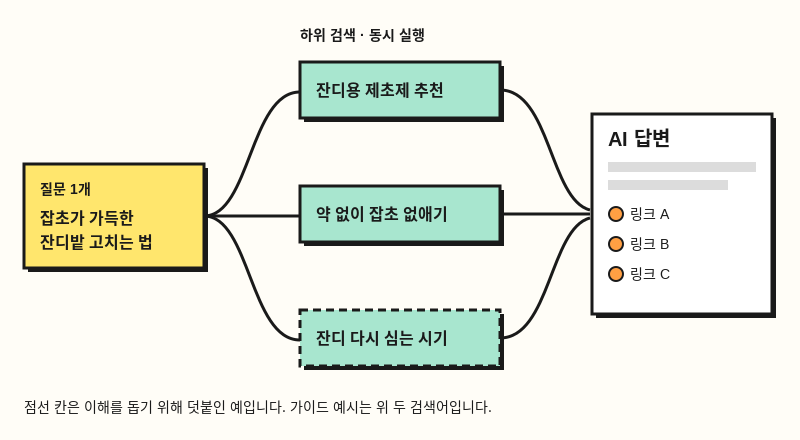 Concept figure: drawn from the lawn example in the generative AI optimization guide; it is not an actual list of sub-searches Google generates. (figure labels in Korean)
Fan-out itself isn't new. Google already described "the query fan-out technique that runs multiple searches at the same time" when it introduced AI Mode in Korean in September 2025, and this announcement is about boosting that fan-out with Hydrogen's reasoning. Putting it side by side with classic search makes the difference clearer.
| Criteria | Classic web search | AI Mode (query fan-out) | After Gemini 4 Hydrogen |
|---|---|---|---|
| How it searches | Finds results for the one query you typed | Splits the question into subtopics and runs several searches at once | Fan-out boosted by reasoning (Google's wording) |
| Result format | List of links | AI answer with links | More images, structured answers, comparison tables, custom tools |
| Range of links | Mostly pages matching the query | More diverse pages found in sub-searches | A broader range of links than before |
| What triggers your page | The query the user typed | Sub-queries the user never typed can trigger it too | Same, with fan-out boosted (Google's wording) |
The last row matters most for marketers, because if your content answers a sub-question the user never typed, it can still be used as a link in the answer. So would it help to build one page for every sub-query?
3. Do you need separate pages for query fan-out?
The short answer is no. The generative AI optimization guide clearly says that making pages for every fan-out variation doesn't work, and that doing it to manipulate rankings violates the scaled content abuse spam policy. It also says that a high quantity of pages doesn't make a website higher quality.
The guide also goes through common advice for AI search one by one, and here it is sorted into decision criteria.
| Category | What | What the guide says |
|---|---|---|
| Not needed | AI text files like llms.txt, AI-only markup | You don't need new files or markup to appear in Google Search |
| Not needed | Chunking content, rewriting in an "AI style" | No need to break content up, no ideal page length, and AI understands synonyms and overall meaning |
| Don't | Mass-producing similar pages for each query variation | Ineffective, and a spam policy violation if done to manipulate rankings |
| Do | Content with experience and expertise that goes beyond common knowledge; stay indexed and eligible to show with a snippet | Generative AI features are rooted in the core ranking and quality systems |
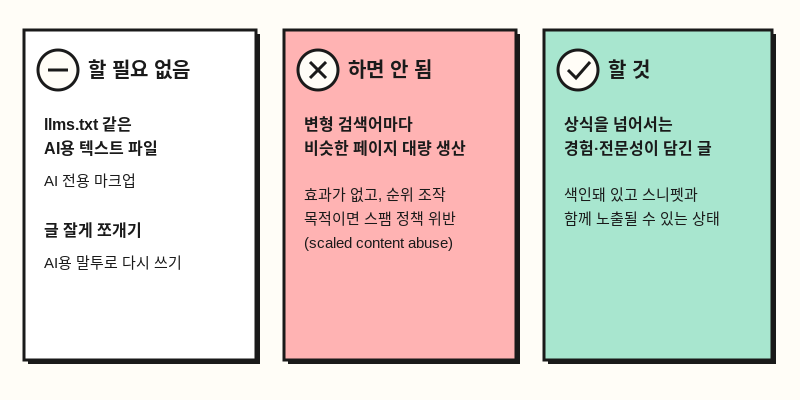 Concept figure: the generative AI optimization guide's points sorted into three groups. (figure labels in Korean)
The phrase the guide stresses is "non-commodity content," meaning not common-knowledge listicles anyone could write, but content with a perspective only someone with real experience and knowledge could offer. This isn't stated in the guide directly, but my reading is that the wider fan-out spreads sub-questions, the more common answers are already covered by many sites, which gives content with a different answer a reason to be chosen as a link. So where should you start in day-to-day work?
4. So what should marketers change?
Let's walk through it step by step with a content manager at an online store selling home-café coffee beans as an example (a hypothetical scenario).
- Spread the main question into sub-questions: For a question like "low-acidity coffee bean recommendations," sub-questions might include roast level, differences by brewing tool, storage, and price range. Writing this list out by hand is the starting point.
- Find the slots only you can answer: Mark the sub-questions only this site can answer, such as its own product information or criteria it set itself. If an existing post is missing that content, adding a section to it fits the guide's direction better than creating a new page.
- Check the technical conditions: To be used as a link, a page must be indexed and eligible to be shown with a snippet. Check that important posts don't have
nosnippet, and that Search Console Settings > Google Search generative AI is set to the default, "Include." - Compare before and after: In Search Console's generative AI performance report, split the dates before and after November 12 and look at impression changes by page. Traffic from AI features is also counted in the Performance report's "Web" search type, so I recommend looking at both reports side by side.
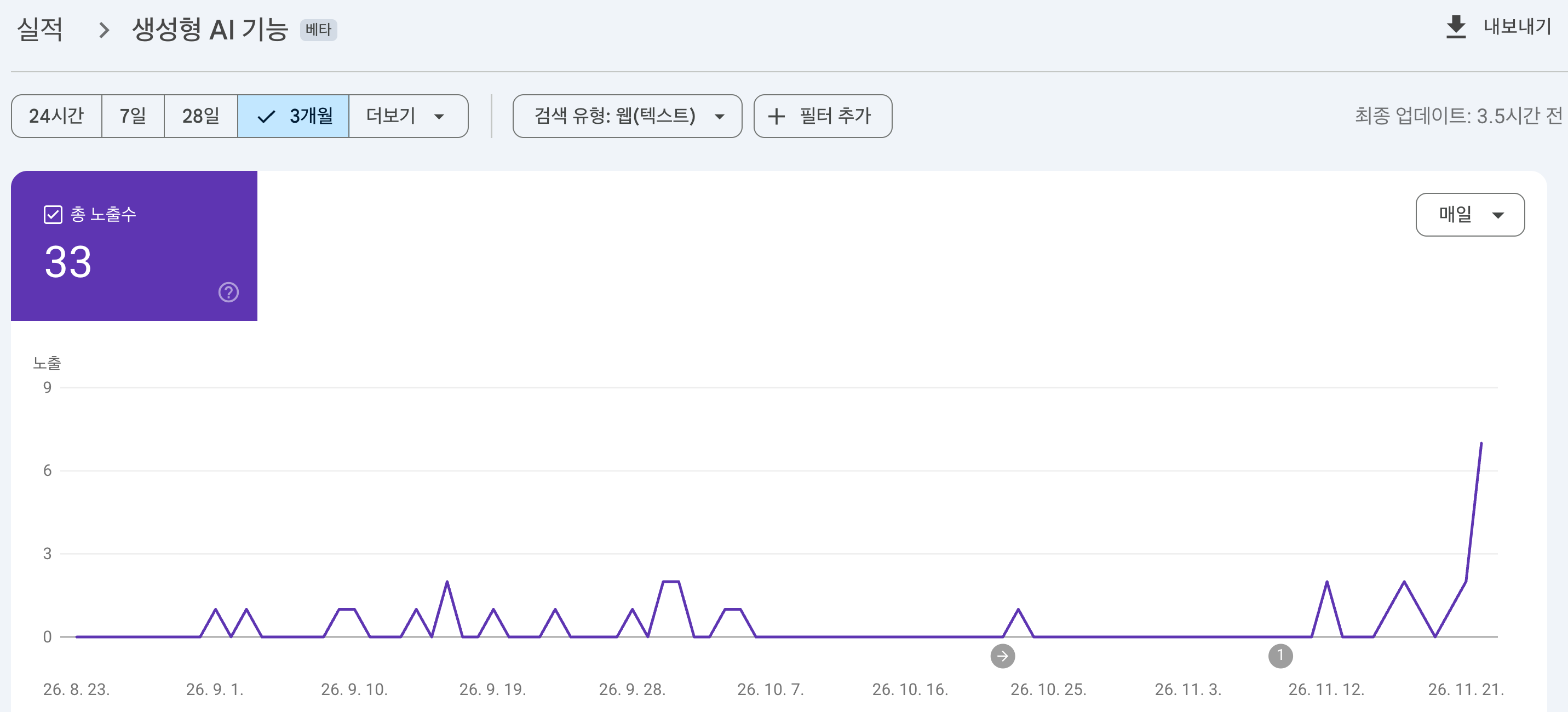 Source: this blog's (nas-bag.me) Search Console "Performance > Generative AI features" report for the last 3 months (checked November 2026). Use "Add filter" at the top to narrow it by page, country or device (screen in Korean).
You can let an AI chatbot draft the sub-question list for step 1, asking something like this (an example prompt; the output is not the sub-searches Google actually generates).
## Role
A content planner who analyzes search intent

## Instructions
Assume a search engine splits the question below into subtopics, and write 8 sub-questions.
For each sub-question, mark whether the post in <material> already answers it: "Yes / Partly / No".

## Format
Table: sub-question | answered? | one line on what to add

## Material
<material>
(Paste the body of the post you're checking)
</material>
The "No" cells in this table are your candidates for improvement, and you can start with the ones you can answer from your own site's experience or criteria. One caution: don't take tools that claim to "show AI Mode's actual fan-out queries" at face value, because the generative AI optimization guide says no third-party tool has access to Google's internal ranking or AI systems.
※ Note: Does this apply to Korean search and AI Overviews?
The announcement only says "all users globally" and "all supported AI Mode languages," with no list of countries or languages.
- AI Mode in Korean: AI Mode has been available in Korean since September 2025, so Korean appears to fall within the supported languages, but the announcement doesn't mention Korea specifically.
- AI Overviews: The Search announcement doesn't mention AI Overviews directly. The AI features guide says AI Mode and AI Overviews may use different models and techniques, so their answers and links can differ, which makes it safer not to assume AI Overviews changed the same way.
- No numbers: Google didn't publish how much broader the links became.
- Report limits: The generative AI performance report may not appear for sites without enough impressions, doesn't include Search Labs experiment data, and the most recent data may be preliminary and change after a few hours.
Wrapping up
Google Search with Gemini 4 Hydrogen aims to connect answers to more diverse sites through query fan-out, which spreads questions out more finely and widely, and what sites should do in response is not to churn out a page for every sub-question but to fill existing posts with what only they can answer. I'll compare this blog's generative AI performance report before and after November 12 and share anything that changes. For Google's own explanation of fan-out, please see the generative AI optimization guide.
FAQ
- What is query fan-out?
- It's a technique where Google's generative AI search features, such as AI Mode, split one question into subtopics and run several related searches at the same time. Google's generative AI optimization guide defines it as a set of concurrent, related queries generated by the model to request more information. Because this process finds more supporting pages, you may see more diverse links than in classic search.
- Can everyone use Gemini 4 Hydrogen in Google Search?
- In its November 12, 2026 announcement, Google said Gemini 4 Hydrogen is available in Google Search for all users globally. However, the announcement has no country list, only says "all supported AI Mode languages," and doesn't mention AI Overviews.
- Do I need llms.txt or special markup for AI Mode SEO?
- No. Google's generative AI optimization guide says you don't need AI text files or new markup to appear in Google Search, and you don't need to chunk your content either. The basics are keeping pages indexed and eligible to show with a snippet, and including experience and expertise that go beyond common knowledge.
More posts to read
- Google AI Mode Links Update: 5 Ways Sources Get More Visible - How link display changed in October and Search Console's generative AI setting
- AI Overviews and SEO: How Google's AI Search Changes Things - How AI Overviews and AI Mode affect SEO, and how to control visibility
- Gemini 4 Argon Launch: Who Can Use It and What It Means for Marketers - The deep-reasoning model in the same Gemini 4 family