Claude Sonnet 5.5 is a model Anthropic released on September 28, 2026. It was introduced as more than 30% faster than Sonnet 5, with costs down by up to 30% on most tasks. If Opus 5.5, which came out earlier on September 22, handles complex work that needs careful judgment, Sonnet 5.5 is the one for well-scoped everyday work, done quickly and cheaply. In this post I cover the differences between the two models and how to choose between them for different kinds of work.
"Should I pick Sonnet or Opus?" If you use Claude, you've probably hesitated at least once in front of the model menu next to the send button. In September especially, Opus 5.5 and Sonnet 5.5 came out back to back on September 22 and 28, so you may be even more curious about how they differ. Below I'll go through what changed in Claude Sonnet 5.5 and how to split work between it and Opus 5.5.
1. What changed in Claude Sonnet 5.5?
According to Anthropic's announcement, Sonnet 5.5 is the second model in the Claude 5.5 family, a faster and cheaper model that complements Opus 5.5. Anthropic highlighted four main changes.
- Speed: Output generation is more than 30% faster than Sonnet 5, and Anthropic says it's the fastest Sonnet model released so far.
- Cost: API pricing is the same as Sonnet 5, at $2 per million input tokens and $10 per million output tokens. But it uses far fewer tokens to do the same work, so the cost per task is down by up to 30%.
- Writing and collaboration: Like Opus 5.5, it writes more clearly than the previous generation, and early testers reportedly rated it a better collaborator than Sonnet 5.
- Performance: It improved over Sonnet 5 in coding, long-running tasks, and image understanding, and on some evaluations it reportedly scored close to Opus 5.5 when run at the highest effort level (Max).
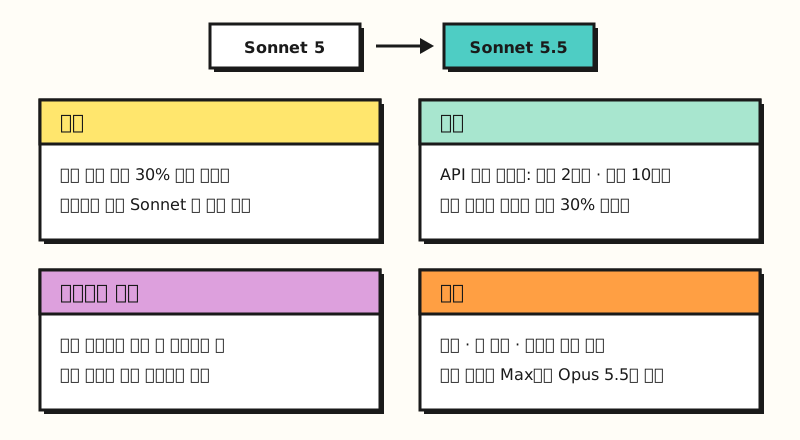 API pricing stayed the same, while speed went up and cost per task went down (figure labels in Korean).
For marketers and planners, the notable part is the work it's described as being strong at. Anthropic said Sonnet 5.5 is strongest at well-scoped everyday tasks, bug fixes, and producing polished documents, slides, and spreadsheets. The announcement also describes an internal test where it was given a listed company's quarterly earnings materials, an earnings call transcript, and a slide template, and asked to build a 10-slide operating review. Two experts judged that the first draft could be sent as is.
So how exactly is it different from Opus 5.5, which was already out?
2. What's the difference between Claude Sonnet 5.5 and Opus 5.5?
Both models belong to the same Claude 5.5 family, but they handle different jobs. Here's a table based on the models overview and the two models' announcements.
| Item | Claude Sonnet 5.5 | Claude Opus 5.5 |
|---|---|---|
| Official description | The best combination of speed and intelligence | For long-running agentic coding and knowledge work |
| Strong at | Well-scoped everyday work, documents, slides, spreadsheets | Complex work that needs careful judgment |
| Relative speed | Fast | Moderate |
| API price (per million tokens) | $2 input, $10 output | $4 input, $20 output |
| Context window | 1M tokens | 1M tokens |
| Max output | 128K tokens | 128K tokens |
The context window, meaning how much the model can read at once, is 1 million tokens for both, and the paid plans help article lists the same size for conversations in the Claude app. Sonnet 5.5 costs half as much. The performance gap is narrower than you might expect. On GDPval-AA, which evaluates real-world tasks across many occupations, Sonnet 5.5 scored 1844, just 2 points below Opus 5.5. Still, Anthropic added that benchmark scores are only one slice of capability, and that Opus 5.5 is clearly stronger on open-ended work that requires sustained judgment.
The relationship between the two is easy to understand if you think of how a team divides work. An experienced lead takes the work that needs direction-setting and lots of judgment, and a fast-moving teammate handles execution within a set framework. In fact, one early tester quoted in the announcement said that once Opus 5.5 sets up the structure and framework of a game, the implementation could be left to Sonnet 5.5.
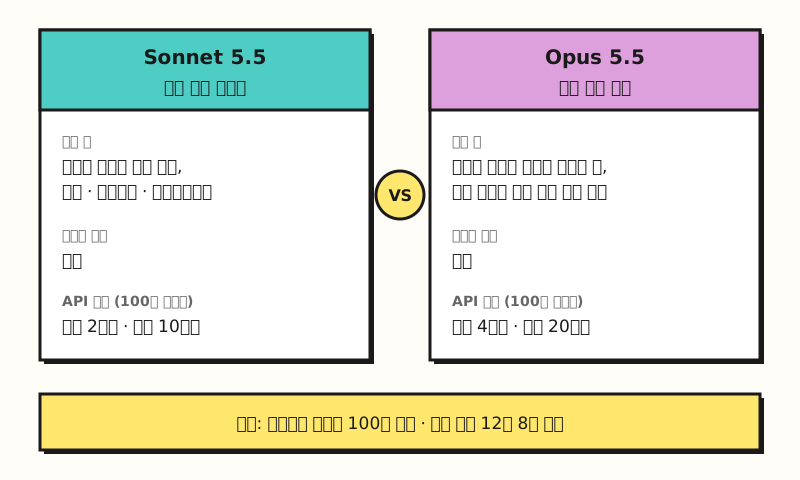 The context window and max output are the same; the jobs they're suited for and the price differ (figure labels in Korean).
3. When should marketers use Sonnet 5.5 vs Opus 5.5?
Applying the official descriptions to day-to-day work, you can split it like this. These are criteria I put together based on the strengths Anthropic described, so adjust them to fit your own work.
- Good fit for Sonnet 5.5: Repetitive work where the shape of the output is clear, like summarizing meeting notes, weekly reports and slides built on a set template, cleaning up spreadsheets, and writing multiple versions of ad copy
- Good fit for Opus 5.5: Market research that pulls evidence from many sources, planning without a fixed right answer such as campaign strategy, and long tasks that run for hours
The Opus 5.5 announcement also includes an internal test of its research ability. It was asked to write a company's quarterly earnings report by gathering information from a web copy where the earnings materials had been made hard to find, and an automated grader checked every figure and citation against the sources. Across several effort levels, 16 of Opus 5.5's 18 reports reportedly passed the quality bar. That's a reason to try Opus 5.5 first for research work where every piece of evidence needs checking.
On the other hand, if you run templated work many times a day, Sonnet 5.5 has the edge in speed and cost. That's because usage on subscription plans also varies by model and effort level. But before switching models, there's one more setting worth trying first.
4. How should you choose the effort level?
According to the model, effort, and thinking settings help article, in the Claude app you can click the model name next to the send button and pick an effort level under "Effort." Both Sonnet 5.5 and Opus 5.5 support this option, and each level is described as follows.
| Effort level | Official guidance |
|---|---|
| Low · Medium | Good for everyday tasks, and your usage lasts longer |
| High | The best balance of quality and speed |
| Extra high (xhigh) | For long-running coding and agentic tasks |
| Max | For tasks that need the deepest reasoning |
Higher effort makes answers more thorough, but it takes longer and uses more tokens, so you hit your usage limit sooner. According to the Sonnet 5.5 announcement, the default in the Claude app and Claude Code is Medium. Anthropic's model selection guide also notes that adjusting the effort level within one model is often better than switching models. So when Sonnet 5.5's output falls short, I'd suggest raising the effort level by one step before jumping straight to Opus 5.5.
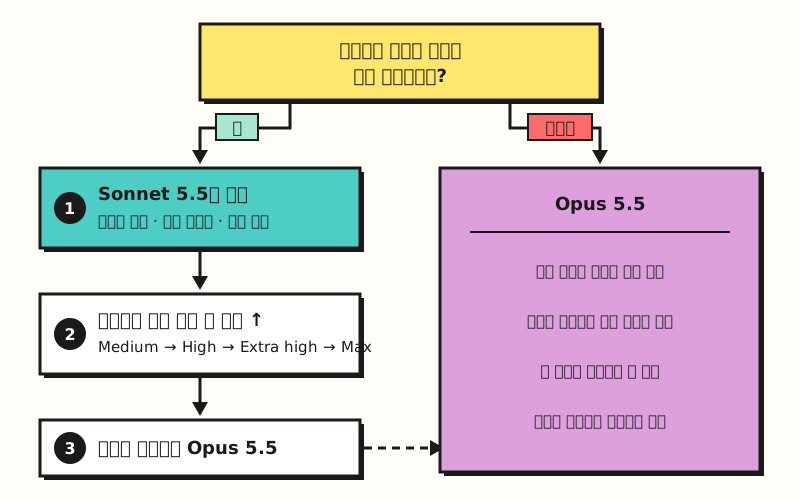 The task categories are my own criteria, based on the strengths Anthropic described (figure labels in Korean).
For reference, in the Claude app you can't turn off thinking for Sonnet 5.5 or Opus 5.5. I've explained what tokens are and how they relate to usage in my post on tokens and context windows.
※ Note: What if you see a notice that the model switched mid-answer?
Sonnet 5.5 is the first Sonnet model to ship with cybersecurity safeguards. According to the model switching help article, high-risk cybersecurity requests like exploit generation or penetration testing are handed off to Sonnet 5, and some requests, such as those that could lead to serious biological harm, are blocked outright. You'll rarely run into this in marketing work, but it's good to know so it doesn't catch you off guard.
- You'll see a notice: When the model switches, a notification appears, and the answer shows which model responded.
- The model menu stays on Sonnet 5: After the switch, the conversation stays on Sonnet 5 until it ends, and you can switch back to Sonnet 5.5 from the model menu at any time.
- It also checks content you didn't type: Memory, content pulled in through connectors, web search results, and files are all checked, so a switch can be triggered by content you didn't write.
- You can turn off automatic switching: If you turn off "Switch models when a message is flagged" under Settings > Capabilities, the conversation pauses instead of switching models, and you can edit the message and resend it.
To sum up, Sonnet 5.5 handles templated work quickly and cheaply, while Opus 5.5 goes deep on work that needs a lot of judgment. I'll try handing repetitive work to Sonnet 5.5 at different effort levels and splitting research-heavy planning off to Opus 5.5, then write up the differences again. For detailed figures and evaluation methods, see the Sonnet 5.5 announcement.
FAQ
- Is Claude Sonnet 5.5 more expensive than Sonnet 5?
- API pricing is the same as Sonnet 5, at $2 per million input tokens and $10 per million output tokens. Anthropic said Sonnet 5.5 handles the same work with fewer tokens, so the cost per task is up to 30% lower than Sonnet 5.
- What's the difference between Sonnet 5.5 and Opus 5.5?
- Sonnet 5.5 is strong at well-scoped everyday work and documents, slides, and spreadsheets, it's faster, and its API price is half that of Opus 5.5. Opus 5.5 is strong at complex work that needs sustained, careful judgment. Both models have a 1-million-token context window (on the API and paid plans).
- If Sonnet 5.5's answer falls short, should I switch straight to Opus 5.5?
- Anthropic's model selection guide says adjusting the effort level within one model is often better than switching models. Try raising the effort level by one step first, and if that's still not enough, try Opus 5.5.
- Is Claude Haiku 5.5 out yet?
- Not yet. The Sonnet 5.5 announcement said Haiku 5.5 will join the Claude 5.5 family in the coming weeks, and at the time of writing, the models overview still lists Haiku 4.5.
Related posts
Posts worth reading once you've picked a model.
- What Are Tokens and Context Windows? Basics Before Feeding AI Long Documents - What a 1M-token context and per-token pricing actually mean
- Prompt Writing Basics: Clear Instructions, Context and Roles, Examples, Output Format - How to write instructions that shape results no matter which model you use
- Claude Marketplace Launch: How Connectors, Skills, and Plugins Differ - Ways to connect your work tools to Claude