The AI exception in Korea's Personal Information Protection Act (PIPA) lets a business that lawfully collected personal data in the first place use it for AI technology development, but only when pseudonymized or anonymized data isn't enough, the public or social need is recognized, and the Personal Information Protection Commission (PIPC) has deliberated and approved it. The law takes effect on March 9, 2027, and on November 23 the PIPC issued a draft amendment to the Enforcement Decree with the detailed standards for public comment. The draft includes four enhanced safeguards, the cases that need a prior risk factor assessment, a separate expert committee and criteria for streamlining similar cases, and comments are open until January 4, 2027.
"Can't we train a chatbot on our customer service logs?" As AI spreads inside companies, marketing and CRM staff are probably hearing this question more often. The customer data is already in-house, but it has always hit a wall because the purpose you told customers when you collected it wasn't AI development. In this post, let's go through what the PIPA AI exception allows and requires, how it differs from consent or pseudonymization, and what marketers can check right now.
What changes with the PIPA AI exception?
Until now, even personal data collected lawfully through consent or a contract needed the data subject's separate consent or a legal basis to be used for a different purpose. Otherwise it had to be used in pseudonymized or anonymized form, which made AI development difficult, as the PIPC press release (August 20, 2026) explains. So far, some services such as AI voice phishing prevention and autonomous robot development could use video and audio data containing personal data through the regulatory sandbox, but that was a temporary exception of two years by default and four years at most.
That's why the National Assembly passed an amendment with the AI development exception at its plenary session on August 20, 2026, and the law was promulgated as Act No. 21910 on September 8, 2026, taking effect on March 9, 2027. To use the exception, you need to meet all of the following.
- Only the original collector: It applies to the controller that lawfully collected the personal data in the first place.
- When pseudonymized or anonymized data isn't enough: AI development must be difficult with pseudonymized or anonymized data alone.
- Public or social benefit: It applies only when a public or social need is recognized.
- Enhanced safeguards + deliberation: You need enhanced safeguards and a deliberation and decision by the PIPC.
On top of that, when the risk is high, such as processing sensitive data or unique identifiers, you must assess risk factors in advance and prepare improvements, and businesses using the exception must disclose the key details in their privacy policy. The PIPC is also required to publish how the exception is being used on its website.
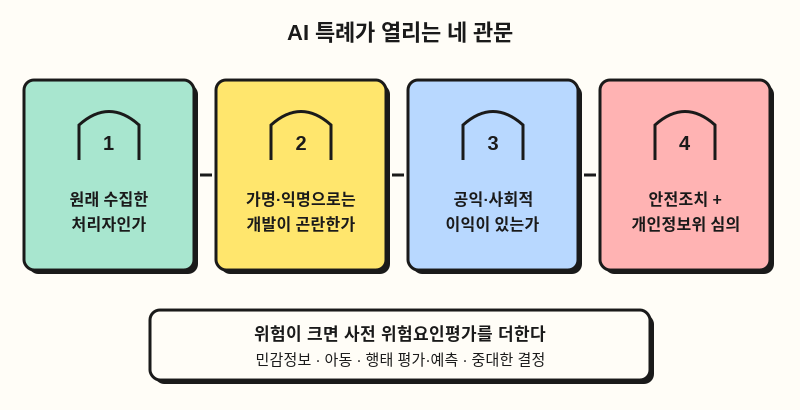 The exception opens only after all four gates, and a prior risk factor assessment is added when the risk is high. (figure labels in Korean)
As an analogy, the AI exception is like applying to use a library's rare books room. The materials (original personal data) are already in the library, but you have to explain why a copy (pseudonymized data) won't work for your research and why it serves the public, and even with permission you read them only in a designated room, only the named people see them, and you return them when you're done. You can think of this draft decree as the document that spells out those reading room rules.
What standards are in the November 23 draft decree?
The PIPC press release (November 23, 2026) lists four main points in the draft.
- Enhanced safeguards: On top of the existing security measures, the draft makes these mandatory for personal data under the exception: appointing a responsible officer and setting up and running an internal management plan, preventing use outside the approved scope, restricting and controlling access, and destroying the data once it's no longer needed. Depending on the nature of the data or how the AI output will be used, the PIPC can also attach additional safeguards as conditions.
- Cases needing a prior risk factor assessment: These include using sensitive data or unique identifiers, reflecting the characteristics of data subjects who need special protection such as children, developing AI that continuously monitors or tracks data subjects or evaluates or predicts their characteristics or behavior, and cases expected to be used for judgments or decisions with a significant impact on data subjects' rights.
- Deliberation criteria and an expert committee: The draft sets criteria and procedures for deliberation, and a separate expert committee with AI and privacy experts reviews the matters in advance.
- Streamlining similar cases: The procedure can be streamlined when there's no material difference from an earlier decision in development purpose, type and scope of personal data, or processing method and environment. However, it isn't streamlined if a new privacy risk arises or an existing risk increases significantly.
The PIPC said it will collect comments until January 4, 2027, go through review by the Ministry of Government Legislation, and finish the amendment in time for the law's effective date of March 9. The full draft is attached to the PIPC notice, and comments can be submitted through the National Participation Legislation Center or by email to the PIPC.
Consent, pseudonymization or the AI exception: how do they differ?
I split the paths marketers might think of for using customer data for AI development, beyond its original purpose, into four. Leaving aside cases with a separate legal basis, here is what each path requires, side by side.
| Criteria | Separate consent | Pseudonymized or anonymized data | AI exception (from Mar 9, 2027) | Regulatory sandbox |
|---|---|---|---|---|
| Original data | Used within the consent scope | Used in a form that makes people hard to identify | Original data can be used | Used within the allowed scope |
| Key condition | Separate consent from each data subject | Pseudonymization or anonymization | Pseudonymization not enough + public or social benefit + safeguards | Approval for a specific service |
| Who decides | Each customer | The controller | PIPC deliberation and decision | Sandbox approval |
| Period | Depends on consent scope | Depends on pseudonymized data rules | Destroyed once no longer needed | Two years by default, four at most |
| Fits when | New data you collect, a small number of customers | Analysis or training that doesn't need identification | Original data is truly needed and you can explain the public benefit | Some innovative services before the exception takes effect |
As the table shows, the AI exception is closer to a last door you use when the first two paths are blocked. Because the requirement itself is that pseudonymized or anonymized data alone isn't enough, there's no reason to apply for the exception in the first place if pseudonymization solves your development needs.
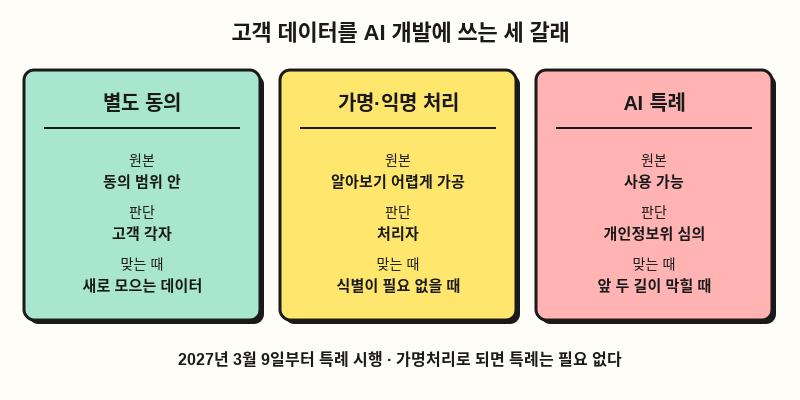 Checking whether pseudonymization works first, and considering the exception only if it doesn't, matches the requirements. (figure labels in Korean)
Can AI built from marketing data qualify for the exception?
The part that stands out most for marketers is "AI that evaluates or predicts characteristics or behavior" among the cases that need a risk factor assessment. A model that predicts churn from purchase history or a recommendation model that infers interests from behavioral data seems to overlap with that description. However, I couldn't find specific criteria in the published materials on which models fall into this category.
The other point is the public or social benefit requirement. Since the law sets this requirement separately, my reading is that development centered on company profit, like a personalized ad model to grow sales, doesn't look likely to get through the exception. This too can't be stated for certain until the deliberation criteria are finalized. So how do situations marketers often face look? Below is how I sorted them against the requirements in the law and press releases, and the actual decision should be made with your company's privacy officer.
| Situation | Relation to this exception | What to do first |
|---|---|---|
| You want to train a customer service chatbot on support logs | Counts as AI development. The question is whether original data is really needed | Test whether pseudonymized data with names and contact details removed works |
| You want to build a churn prediction model from purchase history | Overlaps with "AI that evaluates or predicts". Explaining public benefit may be hard | Design with pseudonymized data and hold off on the exception |
| You paste customer inquiries into an existing generative AI tool to summarize them | This is using AI, not "developing" it, so it isn't what this exception covers | Check your company's AI usage policy and the tool's training settings |
| You build a market analysis AI from public statistics | No personal data means no need for the exception | Check whether personal data is mixed into the data |
The third row is easy to confuse. The exception covers use for the purpose of "AI technology development", and the press releases don't cover putting materials into an AI service that already exists. For that, it makes more sense to refer to materials like the PIPC's Privacy Guide for Generative AI Service Users from May, which covers training opt-out and chat history settings.
So what should marketers prepare?
With a little over three months until the law takes effect, it's more realistic to sort out which path your data falls into ahead of time rather than applying for the exception right away. Let's walk through it in order, assuming you're a CRM manager who has been asked to build a chatbot from support logs (this is a hypothetical scenario).
- Check the collection basis: Find the privacy policy and consent wording to see what purpose was stated when those support logs were first collected. This matters because only a controller that lawfully collected the data can use the exception.
- Split by column: Pull out only the column names to see what items are in the data, and sort them into identifiers, sensitive data and general data.
- Test whether pseudonymization works: First see whether you can reach the goal with data where identifiers are removed or replaced. If you can, you don't need the exception.
- Check the risk assessment cases: Mark whether any of the four apply: sensitive data, children's data, behavior prediction or use for significant decisions.
- Prepare the privacy policy disclosure: If you do use the exception, you must disclose the key details in your privacy policy, so decide in advance who will update it and when.
Step 2 can be handed to AI, but it's important to enter only the column names, not the customer data itself. Below is a sample prompt you can paste as is.
## Role
You are a data classifier who helps with privacy work.

## Instructions
Look at the column names below and classify each as an identifier,
sensitive data (health, religion, etc.) or general data.
Mark any column that is hard to judge as "Needs review" and give a one-line reason.

## Format
| Column name | Category | Reason |

## Data
<data>
Customer ID, Name, Mobile number, Contact date and time, Inquiry type, Inquiry details, Product purchased, Age group
</data>
The AI's classification is only a draft, and the final call should be made together with your privacy officer. Still, even this table gives you a starting point for discussing "is pseudonymization enough, or do we need the exception?" Also keep in mind that if you have comments on this draft, you can submit them through the National Participation Legislation Center before January 4, 2027.
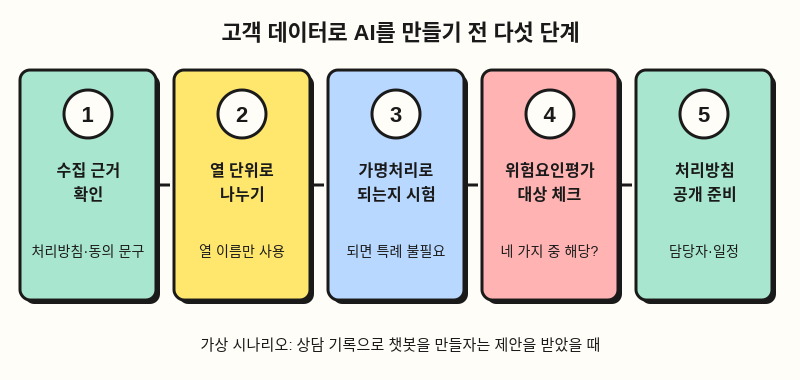 Before applying for the exception, first sort out which path your data falls into. (figure labels in Korean)
※ Note: What isn't decided yet
- This is a draft for public comment. The content may change through the comment period and review by the Ministry of Government Legislation.
- How to apply for deliberation, required documents and processing time aren't in the press release. You'll need to check the full draft and later PIPC guidance.
- I haven't yet found the criteria for judging public or social benefit or concrete examples of which models count as "AI that evaluates or predicts".
- This post is a study note written from laws and government press releases, so please confirm actual data use with your company's privacy officer or a legal expert.
Wrapping up
The PIPA AI exception opens a path in law, for the first time, to use original customer data for AI development, but it's a narrow door: only when pseudonymization or anonymization won't work, only when there's a public benefit, and only after deliberation. What marketers can do now is sort out the collection basis and items in their data and check first whether pseudonymization works. I'll share what changed once the decree is finalized and the first deliberation cases are published, so until then, please refer to the checklist above.
FAQ
- When does the PIPA AI exception apply?
- The law was promulgated on September 8, 2026 and takes effect on March 9, 2027. The draft Enforcement Decree with the detailed standards is open for public comment from November 23, 2026 to January 4, 2027, and the PIPC said it plans to finish the decree amendment in time for the law's effective date.
- Once the AI exception exists, can we use data for AI training without customer consent?
- Conditions apply. The controller that lawfully collected the data in the first place must find AI development difficult with pseudonymization or anonymization, a public or social need must be recognized, enhanced safeguards must be in place, and the PIPC must deliberate and decide. If you use the exception, you must disclose the key details in your privacy policy.
- How is it different from training AI on pseudonymized data?
- Pseudonymized data is data changed so people are hard to identify, while the AI exception uses the original personal data. Because the requirement itself is that "AI development is difficult with pseudonymized or anonymized data alone", development that pseudonymization can handle is unlikely to qualify for the exception.
- When is a risk factor assessment required?
- The draft decree lists cases including using sensitive data or unique identifiers, reflecting the characteristics of data subjects who need special protection such as children, developing AI that continuously monitors or tracks data subjects or evaluates or predicts their characteristics or behavior, and cases expected to be used for judgments or decisions with a significant impact on their rights.
Related posts
- AI Ad Labeling in Korea: Virtual Person Labels and the Nov 27 Ban - Another AI rule marketers should know
- What Is RAG? How to Connect Company Data to AI for Answers - How to use company data with AI without training on it
- Block AI Training in robots.txt: Google-Extended vs GPTBot - The other side: keeping your site content out of AI training