Genie 4 is a world model that Google DeepMind unveiled on October 27, 2026: an AI that generates a world you describe in text in real time, and responds instantly on screen when you move around in it or change the weather or characters. This version improves realism and physics and also generates sound and dialogue, but for now only trusted testers can use it, and Google says only that it's coming "soon" to Project Genie for Google AI Ultra subscribers.
"There are lots of AIs that make videos, so what's a world model?" If you follow AI news, you've probably been seeing this term a lot more, but from the name alone it's hard to grasp how it differs from video generation AI. Working in digital marketing, I keep an eye on video AI for making ad creatives, but world models are a bit of a different breed, so I studied them separately. In this post, I'll go through what a world model is, what changed in Genie 4, and how far you can try it right now.
1. What Is a World Model, and How Is It Different from Video Generation AI?
In its Genie 3 announcement, Google DeepMind described world models as AI systems that use their understanding of the world to simulate aspects of it. The idea is that when AI agents use such models, they can predict how an environment will change and how their own actions will affect it.
The biggest difference from video generation AI is that it responds to user input in real time. According to the Genie 3 announcement, Genie's worlds are generated frame by frame based on the initial world description and the user's actions, and this computation happens again multiple times per second as new input comes in. So remembering the scenes you've already passed and continuing without contradicting them becomes the core challenge.
As an analogy, if video generation AI is like playing a movie that was filmed in advance, a world model is closer to an improvised stage where the backdrop and props are painted on the spot while the audience walks around on stage. When the audience turns to the left, that view has to be newly drawn, and when they turn back, the tree they saw earlier has to still be in its place.
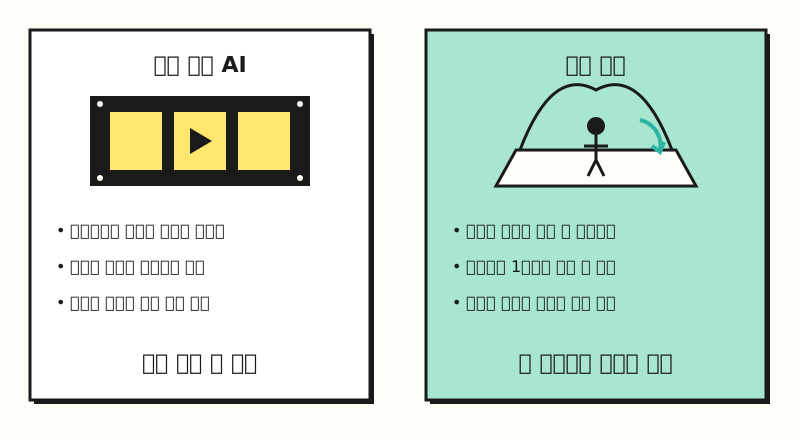 Illustration: not an actual product screen, but a simple comparison of how the two approaches differ. (figure labels in Korean)
DeepMind sees world models as an important stepping stone toward artificial general intelligence (AGI), since they can serve as environments for training robots and AI agents. So what changed in Genie 4 compared with the previous version?
2. What's New in Genie 4?
The changes described in Google's blog announcement of Genie 4 and DeepMind's announcement fall into roughly four groups.
- Realism and physics: It highlights more realistic visuals and natural movement, and also simulates physical phenomena like airflow and collisions.
- Human movement: Characters move naturally in response to their surroundings, and you can also control them in real time.
- Sound and dialogue: Ambient sound, music, and character dialogue are generated along with the world, and DeepMind introduced Genie 4 as its first real-time world model that generates sound natively.
- Changing scenes with text: You can give natural-language instructions to move the camera, change the weather, or add people or objects, and a Gemini model watches the scene and adjusts it so the world stays consistent.
For reference, when Genie 3 was announced in August 2025, it was described as allowing real-time exploration at 720p resolution and 24 frames per second while staying consistent for a few minutes. The Genie 4 announcement doesn't give numbers like resolution or frame rate, so it's still hard to compare specs directly.
As a future direction, DeepMind presented a hybrid world model, a division of roles where Gemini sets up the world's structure and plans the story flow, and Genie renders, pixel by pixel, how that world looks, sounds, and reacts. In terms of the improvised stage analogy above, Gemini handles directing while Genie handles set design and sound, but this structure has been presented as a research direction, not a feature with a release date.
3. Who Can Try Genie 4, and When?
According to the announcement, Genie 4 is at the research preview stage for trusted testers. Google said it will be available "soon" in Project Genie for Google AI Ultra subscribers and to early access partners on the Gemini API and Google AI Studio, and it has also opened a waitlist sign-up form.
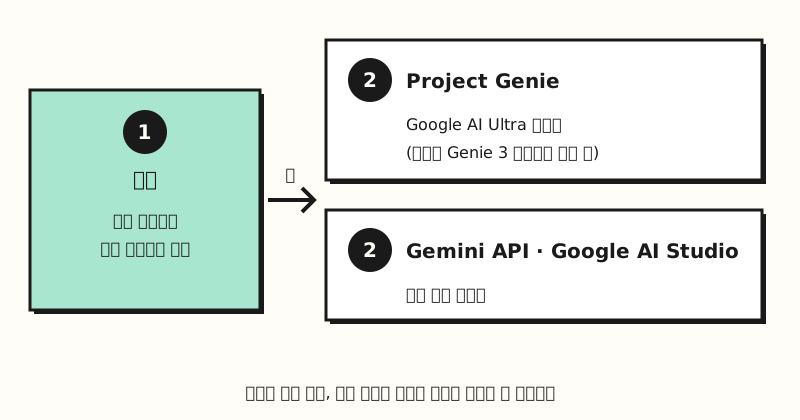 Illustration: the audiences named in the announcement arranged as stages; no dates have been announced yet. (figure labels in Korean)
※ Note: What Is Project Genie Right Now?
According to the Project Genie getting started help article, Project Genie is currently an experimental Google Labs service, and the help article states that "Genie 3 is an early research model." Before Genie 4 arrives, the conditions are as follows.
- Who: Ultra subscribers in countries where the Google AI Ultra plan is available, age 18 or older, with a personal Google account
- Session time: You can explore each world you create for 60 seconds, and download the experience as a video afterward.
- Credits: Because it's still an early research prototype, Google says creating worlds doesn't use AI credits.
- Real-place generation: Creating worlds from Street View locations only supports places in the United States.
In the January 2026 post that first introduced Project Genie, access was limited to Ultra subscribers in the US age 18 and older, but the current help article broadens the scope to countries where Ultra is available. South Korea is on the list of available countries in the Google AI Ultra help article, so based on the help article, which is the more recent document, Ultra subscribers in Korea may also be eligible for Project Genie. However, there's no date yet for when Genie 4 will come to Project Genie, so it's fair to assume the worlds you see when you log in now are based on Genie 3.
4. What Should Marketers and Planners Look for in Genie 4?
Looking at the trusted tester use cases DeepMind shared, a few scenarios offer hints for marketers and planners too.
- Previsualization before shooting: Filmmakers are running multiple "takes" in real-time simulation, using it as a drafting stage to plan scenes before the actual shoot. It's a flow similar to storyboarding an ad video.
- Building a scene from a single photo: Photojournalists are turning a single archival photo into a near-realistic simulation, and some teams are visualizing how events like sudden floods or wildfires unfold.
- Prototypes for interactive content: Game developers are testing visual styles and rules in natural language before writing engine code.
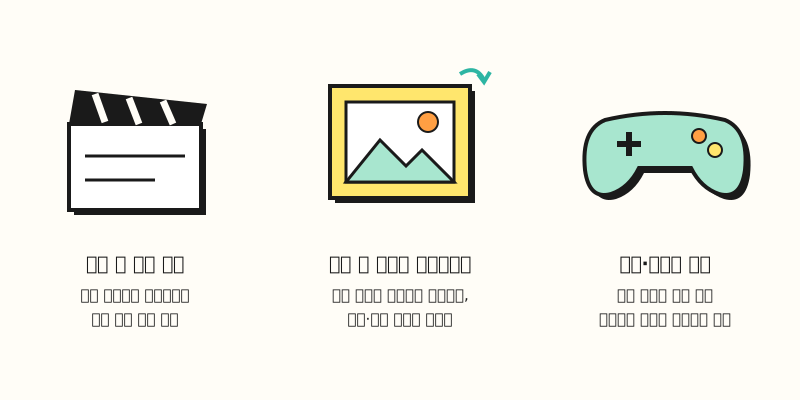 Illustration: the use cases from the announcement drawn as simple object illustrations. (figure labels in Korean)
That said, it's not yet at the stage where you'd use it right away for ad creatives. DeepMind also says Genie 4 is still an early research area, noting that after long sessions or multiple rounds of edited instructions, visual details and object positions can drift slightly. It named complex physical interactions, accuracy of real-time sound, legible text, spatial accuracy, and long-term consistency as challenges still to solve. The fact that legible text is still a research challenge reads to me as meaning it may be hard to use for scenes where text must be accurate, like brand logos or product names.
Also, all video and sound created with Genie 4 reportedly carry a SynthID watermark, so it's good to keep in mind that the output can be identified as AI-generated content when you use it externally.
Summary
Genie 4 is Google DeepMind's world model that generates a world described in text in real time and responds instantly when you move within it or change the scene. It adds realism, physics, and sound and dialogue generation, but for now it's a research preview for trusted testers, so general users will have to wait for Genie 4 to arrive in Project Genie. If you're curious where world models are headed, check out the demo videos in DeepMind's Genie 4 announcement. I'll also write up what's changed once Genie 4 comes to Project Genie.
FAQ
- Can I use Genie 4 right now?
- Not yet. As of the October 27, 2026 announcement, Genie 4 is in a research preview for trusted testers, and Google says only that it will soon be available in Project Genie for Google AI Ultra subscribers and to early access partners on the Gemini API and Google AI Studio. The announcement includes a waitlist sign-up form.
- How is a world model different from video generation AI?
- A world model is an AI that uses its understanding of the world to simulate aspects of it, generating scenes frame by frame in real time in response to the user's actions. It differs from approaches that create and show a fixed video in that when the user changes direction or asks to change the weather, the next scene is generated accordingly.
- Can I use Project Genie in Korea?
- The Project Genie help article says it's available to Ultra subscribers age 18 or older in countries where Google AI Ultra is offered, and South Korea is on the list of countries where Google AI Ultra is available. However, Project Genie is currently based on Genie 3, and creating worlds from Street View locations only supports places in the US.
Related Posts
- Gemini 4 Argon Launch: Who Can Use It and What Changes for Marketers - Google's new Gemini model, used alongside Genie 4 in robot simulation experiments
- How to Check AI-Generated Images: SynthID Detector and Gemini's Verification Feature - How to check for the SynthID watermark that's also in Genie 4 output
- What Are Tokens and Context Windows? Basics Before Feeding Long Documents to AI - Basic concepts that help when understanding AI models