Claude Fable 5.2 is a model Anthropic released on November 9, 2026, built for demanding work like agent tasks that run for hours or research that spans many steps. Its API price is $8 per million input tokens and $40 per million output tokens, lower than Fable 5.1 but twice that of Opus 5.5. That's why Anthropic itself recommends starting most work with Opus 5.5 and moving up to Fable when that falls short.
"A new model is out, so should I just switch everything to Fable?" If you use Claude at work, you may have had that thought when you saw the announcement. The short answer: it's less about changing your everyday default model and more about deciding when to bring Fable in. In this post, let's look at what changed in Claude Fable 5.2, how it differs from Opus 5.5, how much you can use it on each plan, and when it makes sense for a marketer to reach for Fable.
1. What's new in Claude Fable 5.2?
According to Anthropic's announcement, two names arrived together this time: Claude Fable 5.2 and Claude Mythos 5.2. They're the same model. Fable is the version with strong safeguards against misuse in cybersecurity and biology, so you can use it without any extra verification. Mythos drops those restrictions, but only organizations that pass the Cyber Verification or Life Sciences Verification programs can use it. For a typical marketer, Fable is the only one you need to think about.
Compared with Fable 5.1, three changes stand out.
- Price: Per the What's new in Fable 5.2 docs, it dropped from Fable 5.1's $10 input and $50 output (per million tokens) to $8 input and $40 output.
- Speed: The announcement says outputs are up to 30% faster than Fable 5.1.
- Token use: At medium effort, the default in the Claude apps and Claude Code, it reportedly uses fewer tokens than Fable 5.1.
The safeguards also got less strict. The announcement reports about 55% fewer blocks overall than Fable 5.1, and says that blocked queries are answered by Opus 4.8 for cybersecurity and Opus 5 for biology. All you need to know is that if a security-related question gets blocked, you may get an answer from a model other than Fable.
2. How do Fable 5.2 and Opus 5.5 differ?
Two top-tier models from the same company side by side can be confusing. If you lay out the comparison table from the models overview, the differences are simpler than you might expect.
| Item | Fable 5.2 | Opus 5.5 | Sonnet 5.5 | Haiku 5.5 |
|---|---|---|---|---|
| Built for | Demanding reasoning, long-horizon agentic work | Long-running agentic coding and knowledge work | Balance of speed and intelligence | High-volume, fast tasks like classification and extraction |
| API price (per million tokens, input/output) | $8 / $40 | $4 / $20 | $2 / $10 | From $0.10 / from $0.50 |
| Latency (relative) | Moderate | Moderate | Fast | Fastest |
| Default API effort | high | medium | high | medium |
| Context window / max output | 1M / 128K tokens | Same | Same | Same |
The context window (how much it can read at once) and max output are the same across all four models. So "I have a lot of material, so I need Fable" isn't quite right; the difference is how deeply it works through the same material and carries it to the end. The Fable 5.2 model page lists typical uses as agent sessions that run for hours, multistep deep research, and analysis carried through to a finished document, spreadsheet, or deck.
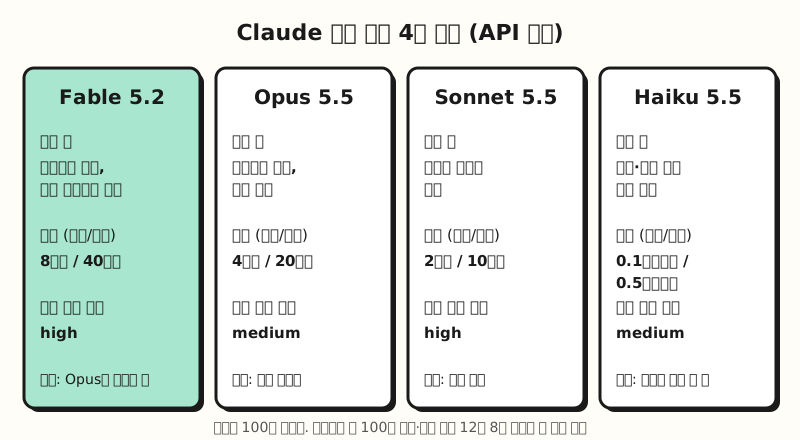 Prices are API prices, and all four models share a 1M-token context window and 128K-token max output. (figure labels in Korean)
As an analogy, if Opus 5.5 is a team lead who finishes most work alone, Fable 5.2 is closer to the senior consultant you call in when the team lead gets stuck. You could seat the consultant in every meeting, but it costs twice as much, and most meetings don't need that level of skill.
3. How much Fable 5.2 do you get on each plan?
To use it in the Claude apps, check your plan first. According to the Claude Fable models on your plan help article, Fable models are available only on paid plans such as Pro, Max, Ultra, Team, and Enterprise, and not on the Free plan.
- Max, Ultra, and premium Team and Enterprise seats: You can use up to 50% of your weekly usage limits on Fable at no extra cost. This doesn't add 50% to your limit; it means up to half of your existing limit can go to Fable.
- Pro and standard Team and Enterprise seats: Fable isn't included in your plan's limits, so it runs on usage credits (pay for what you use) from the start.
- On every plan, Fable models use your limits faster than other Claude models.
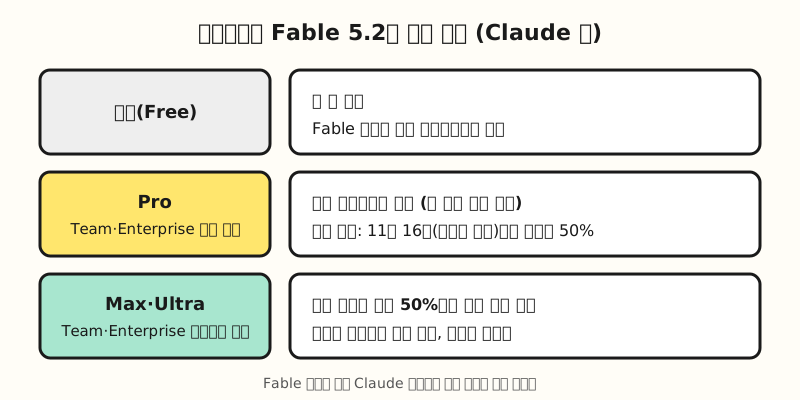 The launch offer is separate; its dates are in the "Note" section below. (figure labels in Korean)
※ Note: the launch offer is short
According to the launch offers help article, a limited-time offer opened with the launch. Pro and standard Team seats can use up to 50% of their weekly limits on Fable for one week, through 11:59 pm Pacific Time on November 16, 2026, and also get one limit reset. Max, Ultra, and premium seats get one to three resets depending on subscription length, and those resets expire on March 8, 2027. Resets go only to accounts with paid billing in place before 10:00 am PT on November 9, and you use one by selecting "Reset for free" under Settings > Usage. If you're on Pro, just keep in mind that this week is your window to try Fable without credits.
4. So what should marketers change?
Keep your default model, and decide ahead of time what signals mean it's time for Fable. That's the change this announcement calls for. The models overview also says that if you're unsure, start most workloads with Opus 5.5 and use Fable 5.2 when Opus 5.5 at higher effort still falls short. Here's how I'd translate that guidance into marketing work. These are my own criteria, based on the use descriptions in the docs.
| Situation | Recommended | Why |
|---|---|---|
| Ad copy variations, email drafts, meeting note summaries | Sonnet 5.5 or Haiku 5.5 | Narrow scope and lots of repetition, so speed and cost matter |
| Commentary on weekly performance reports, first drafts of plans | Opus 5.5 | Needs judgment, but finishes in a single conversation |
| Researching several competitors and finishing a deck | Start with Opus 5.5, move to Fable 5.2 if it stalls | Many steps that must connect, and the flow breaks easily midway |
| Automation that runs for hours (from gathering data to cleaning up a sheet) | Fable 5.2 | Matches the typical uses the docs list |
It also helps to get a feel for cost. Assuming a task uses 100K input tokens and 10K output tokens and counting API prices only, Fable 5.2 comes to $1.20, Opus 5.5 to $0.60, and Sonnet 5.5 to $0.30. In practice, token use varies with effort level, so treat this as an example calculation from the price list alone. Sending work through the Batch API gets a 50% discount on every model, so for large jobs that aren't urgent, consider that first.
5. What if you're building a competitor analysis deck?
Picture someone who, every quarter, researches the new products and promotions of five competitors and turns it into a deck. Rather than starting with Fable, following the order below saves money while bringing in Fable only when it's needed.
- Set the frame with Opus 5.5. Have it define the research items, comparison criteria, and deck outline first.
- Note where it falls short. Write down where sources get tangled, where only some of the five companies get deep coverage, or where conclusions don't match the tables.
- Hand just those parts to Fable 5.2. Pass along the issues you noted and clearly describe the finished form you want.
- A person checks at the end. Open the numbers and source links yourself. This step stays the same no matter which model you use.
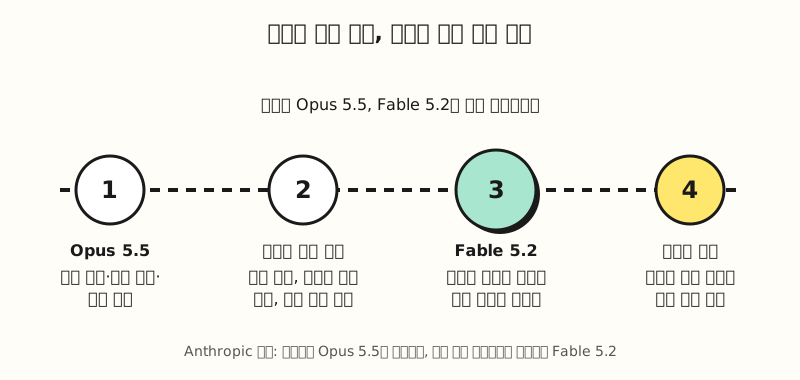 Fable comes in only at step 3, and a person does the final check. (figure labels in Korean)
Here's a prompt template you can use at step 3. It's an example; I haven't verified the output.
## Role
You are a marketing researcher handling competitor analysis for a consumer goods brand.

## Instructions
In the draft below, the comparison of five competitors is uneven.
Research all five again using the same criteria (new products, pricing, promotions, main channels),
and fully complete a 10-slide deck outline with a table for each slide.
Don't stop partway, and mark anything you couldn't verify as "Unverified."

## Format
- For each slide: one-line title, one-line key message, one table
- A list of source links on the last slide

## Material
<material>
(Paste the draft Opus 5.5 produced and the notes from step 2)
</material>
There's a reason for the "don't stop partway" line. The What's new in Fable 5.2 docs say that on long, multistep tasks the model sometimes ends a turn before the work is done, with a list of what remains or an offer to continue, and that this happens more often at low and medium effort. The same page notes that the model follows style rules closely, so a hard limit on sentence length can make its prose choppy. Before carrying over prompts written for earlier models, I'd recommend giving it a read.
Wrapping up
Claude Fable 5.2 is cheaper and faster than Fable 5.1, but it's still twice the price of Opus 5.5, and Anthropic recommends starting most work with Opus 5.5. So the change marketers need isn't switching models, but setting criteria for bringing in Fable only on work that has to carry through many steps to the end. I'll be splitting long research tasks between Opus 5.5 and Fable 5.2 myself, and I'll share anything that changes. For detailed specs by model, see the models overview.
FAQ
- Can I use Claude Fable 5.2 for free?
- No. According to the Claude Fable models on your plan help article, Fable models are available only on paid plans such as Pro, Max, Ultra, Team, and Enterprise, not on the Free plan. Pro and standard seats use usage credits, but as a launch offer they can use up to 50% of their weekly limits on Fable through November 16, 2026 (Pacific Time).
- What's the difference between Fable 5.2 and Opus 5.5?
- Fable 5.2 is for demanding reasoning and long-horizon agentic work, and its API price is twice that of Opus 5.5 for both input and output ($8 and $40 vs. $4 and $20 per million tokens). The context window and max output are the same. Anthropic recommends starting most work with Opus 5.5 and using Fable 5.2 when higher effort still falls short.
- How are Claude Mythos 5.2 and Fable 5.2 different?
- They're the same model. Fable 5.2 has safeguards for cybersecurity and biology so it can be used without extra verification, while Mythos 5.2 drops those restrictions but is available only to organizations that pass Anthropic's verification programs. Specs and pricing are the same.
More related posts
- Claude Sonnet 5.5 vs Opus 5.5 - How to pick between Opus 5.5 and Sonnet 5.5 for your work
- Claude Haiku 5.5 - The smallest model, suited to high-volume repetitive work
- What are tokens and context windows? - The basics for reading "per million tokens" on a price list